CF2138C1 Maple and Tree Beauty (Easy Version)
Description
This is the easy version of the problem. The difference between the versions is that in this version, the constraints on $$$t$$$ and $$$n$$$ are smaller. You can hack only if you solved all versions of this problem.
Maple is given a rooted tree consisting of $$$n$$$ vertices numbered from $$$1$$$ to $$$n$$$, where the root has index $$$1$$$. Each vertex of the tree is labeled either zero or one. Unfortunately, Maple forgot how the vertices are labeled and only remembers that there are exactly $$$k$$$ zeros and $$$n - k$$$ ones.
For each vertex, we define the name of the vertex as the binary string formed by concatenating the labels of the vertices from the root to the vertex. More formally, $$$\\text{name}\_1 = \\text{label}\_1$$$ and $$$\\text{name}\_u = \\text{name}\_{p\_u} + \\text{label}\_u$$$ for all $$$2\\le u\\le n$$$, where $$$p\_u$$$ is the parent of vertex $$$u$$$ and $$$+$$$ represents string concatenation.
The beauty of the tree is equal to the length of the longest common subsequence$$$^{\\text{∗}}$$$ of the names of all the leaves$$$^{\\text{†}}$$$. Your task is to determine the maximum beauty among all labelings of the tree with exactly $$$k$$$ zeros and $$$n - k$$$ ones.
$$$^{\\text{∗}}$$$A sequence $$$a$$$ is a subsequence of a sequence $$$b$$$ if $$$a$$$ can be obtained from $$$b$$$ by the deletion of several (possibly, zero or all) element from arbitrary positions. The longest common subsequence of strings $$$s\_1, s\_2, \\ldots s\_m$$$ is the longest string that is a subsequence of all of $$$s\_1, s\_2, \\ldots, s\_m$$$.
$$$^{\\text{†}}$$$A leaf is any vertex without children.
Input Format
Each test contains multiple test cases. The first line contains the number of test cases $$$t$$$ ($$$1 \\le t \\le 50$$$). The description of the test cases follows.
The first line of each test case contains two integers $$$n$$$ and $$$k$$$ ($$$2 \\leq n \\leq 1000$$$, $$$0 \\leq k \\leq n$$$) — the number of vertices and the number of vertices labeled with zero, respectively.
The second line contains $$$n - 1$$$ integers $$$p\_2, p\_3, \\ldots, p\_{n}$$$ ($$$1 \\leq p\_i \\le i - 1$$$) — the parent of vertex $$$i$$$.
Note that there are no constraints on the sum of $$$n$$$ over all test cases.
Output Format
For each test case, output a single integer representing the maximum beauty among all labelings of the tree with exactly $$$k$$$ zeros and $$$n - k$$$ ones.
Explanation/Hint
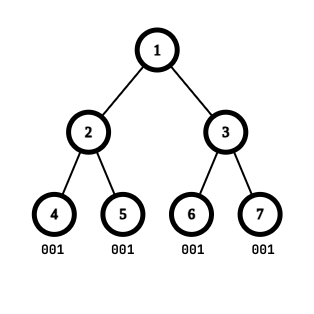 In the first test case, the maximum beauty is $$$3$$$, when the vertices are labeled with $$$\[0, 0, 0, 1, 1, 1, 1\]$$$, and the longest common subsequence is 001. 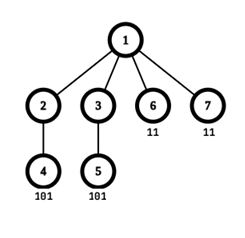 In the second test case, the maximum beauty is $$$2$$$, when the vertices are labeled with $$$\[1, 0, 0, 1, 1, 1, 1\]$$$, and the longest common subsequence is 11.