CF2157B Expansion Plan 2
Description
[ak+q - over the crimson skies](https://soundcloud.com/umbracollective/akq-over-the-crimson-skies)
⠀
You are analyzing an infinite grid with coordinates $ (X, Y) $ (specifically, the cell immediately above $ (0, 0) $ is $ (0, 1) $ , and the cell immediately on the right of $ (0, 0) $ is $ (1, 0) $ ). Initially, only the cell at $ (0, 0) $ is black.
You are given a string $ a_1a_2 \ldots a_n $ of length $ n $ consisting of characters $ \texttt{"4"} $ and $ \texttt{"8"} $ , which describes $ n $ expansion operations. For each $ i $ from $ 1 $ to $ n $ , the following happens for all cells simultaneously:
- if $ s_i = \texttt{"4"} $ : for each cell, if it is orthogonally adjacent to a black cell (i.e., it shares a side), it becomes black; otherwise, its state remains the same;
- if $ s_i = \texttt{"8"} $ : for each cell, if it is orthogonally or diagonally adjacent to a black cell (i.e, it shares a side or a corner), it becomes black; otherwise, its state remains the same.
Is the cell $ (x, y) $ black at the end of the process?
Input Format
Each test contains multiple test cases. The first line contains the number of test cases $ t $ ( $ 1 \le t \le 10^4 $ ). The description of the test cases follows.
The first line of each test case contains three integers $ n $ , $ x $ , $ y $ ( $ 1 \le n \le 2 \cdot 10^5, -10^9 \le x, y \le 10^9 $ ) — the number of expansion operations, and the $ x $ and $ y $ coordinates of the cell you are interested in, respectively.
The second line of each test case contains a string $ s $ of length $ n $ consisting of characters $ \texttt{"4"} $ and $ \texttt{"8"} $ — the types of expansion operations.
It is guaranteed that the sum of $ n $ over all test cases does not exceed $ 2 \cdot 10^5 $ .
Output Format
For each test case, output $ \texttt{YES} $ if the cell $ (x, y) $ is black after the expansion operations described by the string $ s $ , and $ \texttt{NO} $ otherwise.
The judge is case-insensitive (for example, $ \texttt{YES} $ , $ \texttt{Yes} $ , $ \texttt{yes} $ , $ \texttt{yEs} $ will all be recognized as positive answers).
Explanation/Hint
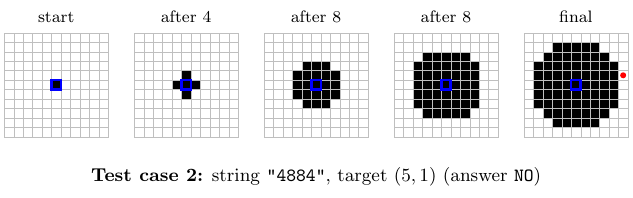
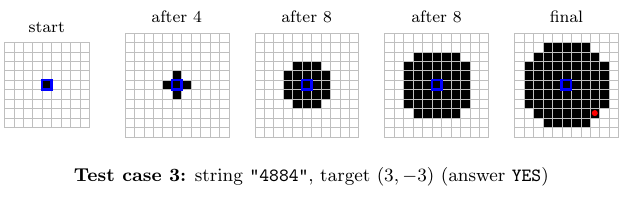
The first three test cases are illustrated below:
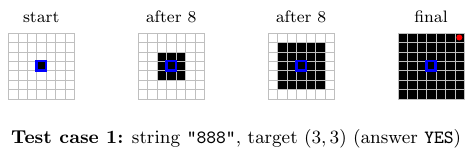  In the first test case, after the expansion operations in the string $ \texttt{"888"} $ , cell $ (3, 3) $ is black, so the answer is $ \texttt{YES} $ .
In the second test case, cell $ (5, 1) $ is white after the expansion operations in the string $ \texttt{"4884"} $ .