CF2170A Maximum Neighborhood
Description
Consider an $ n \times n $ grid filled with numbers as follows:
- the first row contains integers from $ 1 $ to $ n $ from left to right;
- the second row contains integers from $ (n+1) $ to $ 2n $ from left to right;
- this pattern continues until the $ n $ -th row, which contains integers from $ (n^2-n+1) $ to $ n^2 $ from left to right.
Let's define the cost of a cell as its value plus the sum of its neighboring cells' values. Two cells are considered neighboring if they share a side.
Your task is to calculate the maximum cost among all cells in the grid.
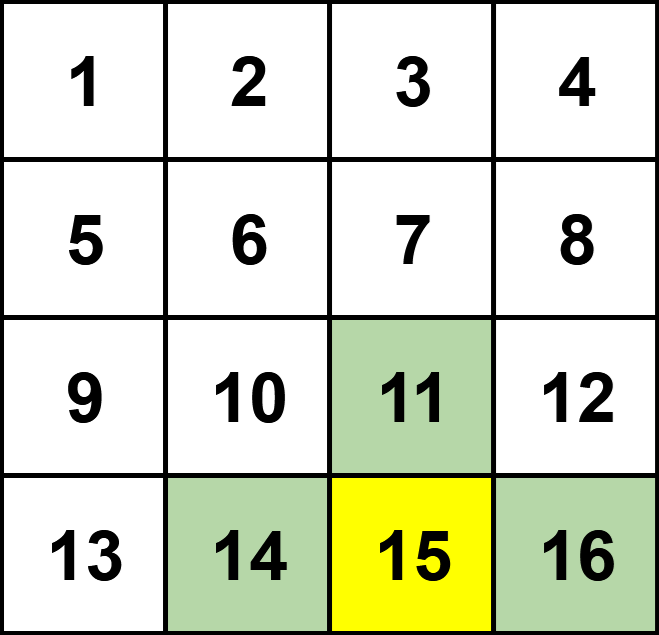 The grid for $ n = 4 $ and the optimal answer for it. The yellow cell has the maximum possible cost; the green cells are its neighbors. The cost of the cell is $ 15+11+14+16=56 $ .
Input Format
The first line contains a single integer $ t $ ( $ 1 \le t \le 100 $ ) — the number of test cases.
The only line of each test case contains a single integer $ n $ ( $ 1 \le n \le 100 $ ).
Output Format
For each test case, print a single integer — the maximum cost among all cells in the grid.
Explanation/Hint
In the first example, there is only $ 1 $ cell with the cost $ 1 $ .
In the second example, the cell with value $ 4 $ has the maximum cost: $ 4 + 2 + 3 = 9 $ .
In the third example, the cell with value $ 8 $ has the maximum cost: $ 8 + 5 + 7 + 9 = 29 $ .
In the fourth example, the cell with value $ 15 $ has the maximum cost: $ 15 + 11 + 14 + 16 = 56 $ .
In the fifth example, the cell with value $ 19 $ has the maximum cost: $ 19 + 14 + 18 + 20 + 24 = 95 $ .