CF2195C Dice Roll Sequence
Description
Consider the following cube $ D $ where numbers $ x $ and $ 7-x $ lie on opposite sides:
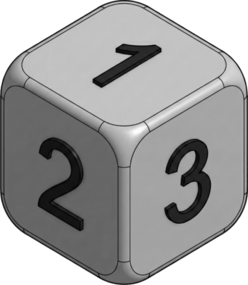 Image generated by Nano Banana Pro.A sequence $ b $ of integers from $ 1 $ to $ 6 $ is called a dice roll sequence if it satisfies the following condition:
- All pairs of adjacent elements lie on adjacent $ ^{\text{∗}} $ sides of the cube.
For example, $ [1,4,2] $ is a dice roll sequence, while $ [3,4,6,3] $ is not because $ 3 $ and $ 4 $ are not on adjacent sides of the dice. Additionally, $ [2,2,4] $ is not a dice roll sequence because $ 2 $ and $ 2 $ are on the same (not adjacent) side of the dice.
Given a sequence $ a $ of $ n $ integers from $ 1 $ to $ 6 $ , you can perform the following operation any number of times (possibly zero).
- Select an index $ 1 \le i \le n $ and an integer $ 1 \le x \le 6 $ . Then, change the value of $ a_i $ to $ x $ .
Please determine the minimum number of operations required to make $ a $ a dice roll sequence.
$ ^{\text{∗}} $ Two sides of the cube $ S $ and $ T $ are called adjacent if they share exactly one edge of the cube. Do note that this condition implies $ S \neq T $ as well.
Input Format
Each test contains multiple test cases. The first line contains the number of test cases $ t $ ( $ 1 \le t \le 10^4 $ ). The description of the test cases follows.
The first line of each test case contains a single integer $ n $ ( $ 1 \le n \le 3 \cdot 10^5 $ ).
The second line of each test case contains $ n $ integers $ a_1,a_2,\ldots,a_n $ ( $ 1 \le a_i \le 6 $ ).
It is guaranteed that the sum of $ n $ over all test cases does not exceed $ 3 \cdot 10^5 $ .
Output Format
For each test case, output the minimum number of operations required to make $ a $ a dice roll sequence.
Explanation/Hint
For the first test case, the sequence $ a $ is $ [1,4,2] $ . As this is already a dice roll sequence, the answer is $ 0 $ .
For the second test case, the sequence $ a $ is $ [3,4,6,3] $ .
Changing exactly one element, you can get $ [3,\color{red}{5},6,3] $ , which is a dice roll sequence.
For the third test case, the sequence $ a $ is $ [6,1,4,3,1,3,2,5,4,4] $ .
Changing exactly $ 4 $ elements, you can get $ [\color{red}{5},1,4,\color{red}{2},1,3,2,\color{red}{1},\color{red}{5},4] $ , which is a dice roll sequence.