CF2219E Weird Chessboard
Description
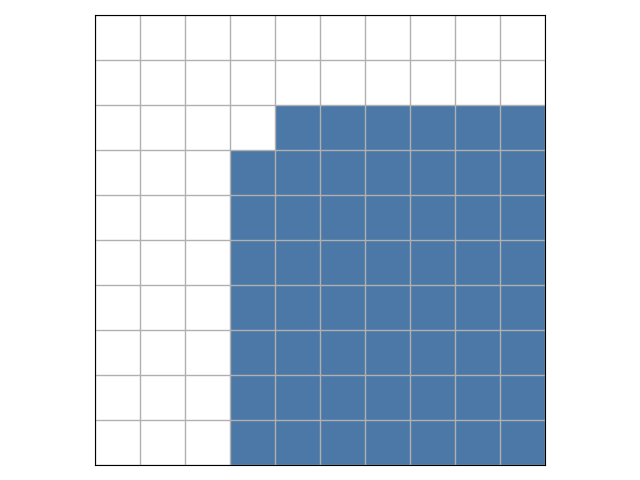
Consider a chessboard (a grid) of size $ n \times n $ . You want to place as many chess pieces on this board as possible. These pieces behave in the following way: if we denote the top-left cell by $ (1,1) $ , then a piece placed in cell $ (i,j) $ can attack every cell $ (x,y) $ such that $ x \ge i $ and $ y \ge j $ , except for $ (i,j) $ itself.
For example, on a $ 10 \times 10 $ board, a piece placed at $ (3,4) $ can attack the cells highlighted below:
Given a chessboard with some pieces placed on it, we say that a cell is good if the number of pieces that attack that cell is even.
Construct a configuration of pieces such that every cell is good, regardless of whether the cell itself contains a piece or not, and the board contains at least $ \lfloor \frac{n^2}{10} \rfloor \cdot 3 $ pieces.
Input Format
Each test contains multiple test cases. The first line contains the number of test cases $ t $ ( $ 1 \le t \le 50 $ ). The description of the test cases follows.
The first line of each test case contains an integer $ n $ ( $ 1 \le n \le 5000 $ ).
It is guaranteed that the sum of $ n^2 $ over all test cases is at most $ 25\,000\,000 = 5000^2 $ .
Output Format
For each test case, print $ n $ lines. In the $ i $ -th line, print $ n $ integers separated by spaces, where a $ 1 $ represents that there is a piece in that cell, and a $ 0 $ represents that there is not.
The $ j $ -th integer in the $ i $ -th line corresponds to cell $ (i,j) $ .
Explanation/Hint
This example is a chessboard of dimensions $ 3 \times 3 $ where every cell is good.
Cell $ (3, 3) $ is good because the cells with pieces $ (1, 3), (2, 3), (2, 2), (3, 1) $ attack it, and this count is 4, which is even.
Cell $ (1, 3) $ is good because no piece attacks it, so the count of pieces that attack this cell is 0.
Cell $ (3, 2) $ is good, and notice that it is required for that cell to be good even though it does not have a piece.