CF2227H Fallen Leaves
Description
Yousef is given a tree $ ^{\text{∗}} $ of $ n $ vertices numbered from $ 1 $ to $ n $ .
Let $ S $ be the set of all leaves $ ^{\text{†}} $ of the given tree (this set is determined from the original tree and does not change).
Yousef repeats the following process until the number of unchosen vertices is at most one:
- Choose two distinct vertices $ u, v \in S $ that have not been chosen before.
- Add $ d(u, v) $ to the total cost, where $ d(u, v) $ is the number of edges on the simple path between $ u $ and $ v $ .
- Mark $ u $ and $ v $ as chosen.
Your task is to help Yousef determine the minimum possible total cost achievable after the process ends.
$ ^{\text{∗}} $ A tree is an undirected connected graph in which there are no cycles.
$ ^{\text{†}} $ A leaf of a tree is a vertex that is connected to at most one other vertex.
Input Format
The first line contains an integer $ t $ ( $ 1 \le t \le 10^4 $ ) — the number of test cases. Then $ t $ test cases follow.
Each test case consists of several lines. The first line of the test case contains an integer $ n $ ( $ 3 \le n \le 2 \cdot 10^5 $ ) — the number of vertices in the tree.
Then $ n − 1 $ lines follow, each of which contains two integers $ u $ and $ v $ ( $ 1 \le u, v \le n $ , $ u \ne v $ ) that describe a pair of vertices connected by an edge. It is guaranteed that the given graph is a tree and has no loops or multiple edges.
It is guaranteed that the sum of $ n $ over all test cases does not exceed $ 2 \cdot 10^5 $ .
Output Format
For each test case, output a single integer — the minimum possible total cost achievable after the process ends.
Explanation/Hint
In the first test case, the set of leaves $ S $ contains $ \{1, 3, 4\} $ . Yousef can do the following:
- Choose $ u = 1 $ , $ v = 3 $ , with $ d(1, 3) = 2 $ . Yousef adds $ 2 $ to the total cost and marks vertices $ 1 $ and $ 3 $ as chosen.
Since there is one vertex left unchosen, the process stops, and the total cost is $ 2 $ . It can be shown that $ 2 $ is the minimum answer.
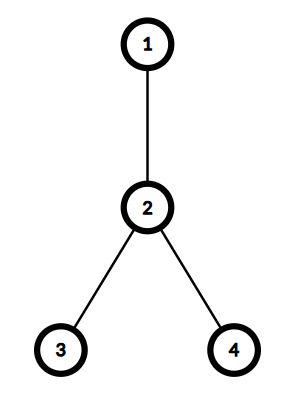 The given tree in the first test case.In the second test case, the set of leaves $ S $ contains $ \{1, 3, 5, 6\} $ . Yousef can do the following:
- Choose $ u = 1 $ , $ v = 3 $ , with $ d(1, 3) = 2 $ . Yousef adds $ 2 $ to the total cost and marks vertices $ 1 $ and $ 3 $ as chosen.
- Choose $ u = 5 $ , $ v = 6 $ , with $ d(5, 6) = 2 $ . Yousef adds $ 2 $ to the total cost and marks vertices $ 5 $ and $ 6 $ as chosen.
Since there is no vertex left unchosen, the process stops, and the total cost is $ 4 $ .
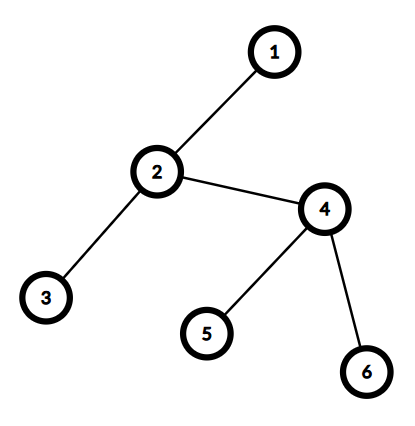 The given tree in the second test case.