CF2229E Deconstruction Tree
Description
A tree with $ n $ nodes fell from the sky along with an initially empty set $ S $ . Ecstatic by this unlikely event, you do the following $ n - 1 $ times:
- let $ x $ be the leaf with maximum index.
- add $ x $ into $ S $ (note that if $ x $ is already in $ S $ then nothing changes).
- select any leaf other than $ x $ and remove it from the tree.
Determine the number of distinct sets $ S $ you can make. As the number could be ginormous, output it modulo $ 998\,244\,353 $ .
Input Format
Each test contains multiple test cases. The first line contains the number of test cases $ t $ ( $ 1 \le t \le 10^4 $ ). The description of the test cases follows.
The first line of each testcase contains an integer $ n $ ( $ 2 \le n \le 2 \cdot 10^5 $ ) — the size of the tree.
Then $ n - 1 $ lines follow, each of which contain two integers $ u $ and $ v $ ( $ 1 \le u,v \le n, u \ne v $ ), which describe a pair of vertices connected by an edge. It is guaranteed that the given graph is a tree.
It is guaranteed that the sum of $ n $ over all test cases does not exceed $ 2 \cdot 10^5 $ .
Output Format
Output the number of distinct sets that can be obtained modulo $ 998\,244\,353 $ .
Explanation/Hint
For the first testcase, there is only one possible order: $ 1 $ , making the set $ \{2\} $
For the third testcase, the tree looks as follows:
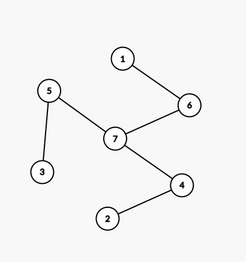you can make the sets:
- $ \{3, 6, 7\} $ by removing in the order $ 1, 2, 3, 4, 5, 6 $
- $ \{3, 4, 6, 7\} $ by removing in the order $ 2, 1, 3, 4, 5, 6 $
- $ \{3, 4, 5, 6, 7\} $ by removing in the order $ 2, 3, 1, 4, 5, 6 $
It can be proven that these are the only sets obtainable.