CF2247E Build a Tree
Description
You are given two integers $ n $ and $ k $ .
Construct a tree $ ^{\text{∗}} $ with $ n $ vertices such that $ \sum\limits_{i = 1}^{n} \operatorname{dist}(i, (i \bmod n) + 1) = k $ $ ^{\text{†}} $ , or determine that no such tree exists.
$ ^{\text{∗}} $ A tree is a connected graph without cycles.
$ ^{\text{†}} $ $ \operatorname{dist}(i, j) $ is the number of edges on the shortest path from vertex $ i $ to vertex $ j $ in the tree.
Input Format
Each test contains multiple test cases. The first line contains the number of test cases $ t $ ( $ 1 \le t \le 10^4 $ ). The description of the test cases follows.
The only line of each test case contains two integers $ n $ and $ k $ ( $ 2 \le n \le 2 \cdot 10^5 $ , $ 0 \le k \le n^2 $ ) — the number of vertices in the tree and the required value of $ k $ .
It is guaranteed that the sum of $ n $ over all test cases does not exceed $ 2 \cdot 10^5 $ .
Output Format
For each test case, if there is no solution, output $ -1 $ .
Otherwise, output $ n - 1 $ lines. Each line should contain two integers $ u $ and $ v $ ( $ 1 \le u, v \le n $ ), denoting an edge of the tree. The edges may be output in any order.
If there are multiple suitable trees, output any of them.
Explanation/Hint
In the first example, the tree consists of the single edge $ (1, 2) $ . Therefore, $ \operatorname{dist}(1, 2) + \operatorname{dist}(2, 1) = 1 + 1 = 2 $ .
In the second example, one possible tree is shown below.
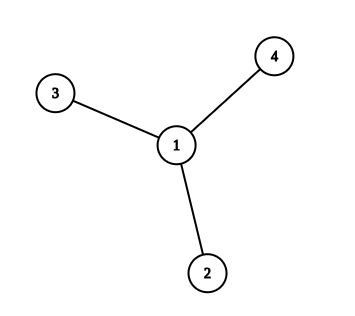For this tree, $ \operatorname{dist}(1, 2) + \operatorname{dist}(2, 3) + \operatorname{dist}(3, 4) + \operatorname{dist}(4, 1) = 1 + 2 + 2 + 1 = 6 $ .
In the fourth example, it can be shown that no suitable tree exists.