CF388E Fox and Meteor Shower
Description
There is a meteor shower on the sky and there are $ n $ meteors. The sky can be viewed as a 2D Euclid Plane and the meteor is point on this plane.
Fox Ciel looks at the sky. She finds out that the orbit of each meteor is a straight line, and each meteor has a constant velocity. Now Ciel wants to know: what is the maximum number of meteors such that any pair met at the same position at a certain time? Note that the time is not limited and can be also negative. The meteors will never collide when they appear at the same position at the same time.
Input Format
The first line contains an integer $ n $ ( $ 1
Output Format
Print a single integer — the maximum number of meteors such that any pair met at the same position at a certain time.
Explanation/Hint
In example 1, meteor 1 and 2 meet in $ t $ =-1 at (0, 0).
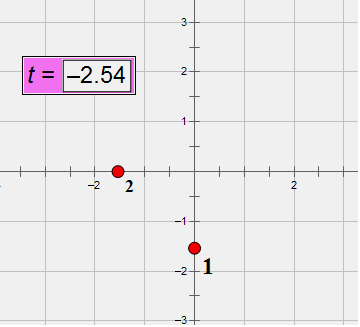In example 2, meteor 1 and 2 meet in $ t $ =1 at (1, 0), meteor 1 and 3 meet in $ t $ =0 at (0, 0) and meteor 2 and 3 meet in $ t $ =2 at (0, 1).
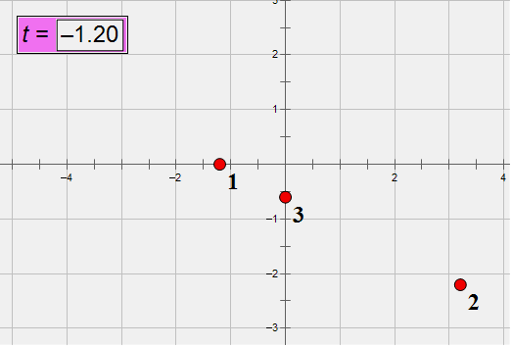In example 3, no two meteor meet.
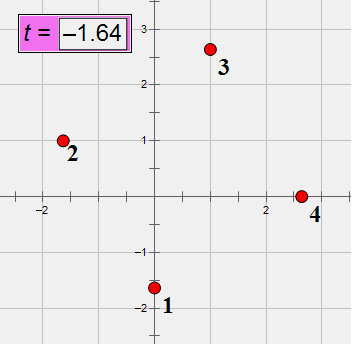In example 4, there is only 1 meteor, and its velocity is zero.
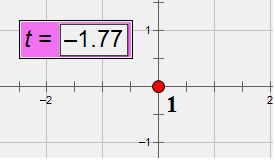If your browser doesn't support animation png, please see the gif version here:
http://assets.codeforces.com/images/388e/example1.gif
http://assets.codeforces.com/images/388e/example2.gif
http://assets.codeforces.com/images/388e/example3.gif
http://assets.codeforces.com/images/388e/example4.gif