CF599D Spongebob and Squares
Description
Spongebob is already tired trying to reason his weird actions and calculations, so he simply asked you to find all pairs of n and m, such that there are exactly $ x $ distinct squares in the table consisting of $ n $ rows and $ m $ columns. For example, in a $ 3×5 $ table there are $ 15 $ squares with side one, $ 8 $ squares with side two and $ 3 $ squares with side three. The total number of distinct squares in a $ 3×5 $ table is $ 15+8+3=26 $ .
Input Format
The first line of the input contains a single integer $ x $ ( $ 1
Output Format
First print a single integer $ k $ — the number of tables with exactly $ x $ distinct squares inside.
Then print $ k $ pairs of integers describing the tables. Print the pairs in the order of increasing $ n $ , and in case of equality — in the order of increasing $ m $ .
Explanation/Hint
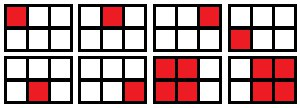
In a $ 1×2 $ table there are $ 2 $ $ 1×1 $ squares. So, $ 2 $ distinct squares in total.
In a $ 2×3 $ table there are $ 6 $ $ 1×1 $ squares and $ 2 $ $ 2×2 $ squares. That is equal to $ 8 $ squares in total.