CF715C Digit Tree
Description
ZS the Coder has a large tree. It can be represented as an undirected connected graph of $ n $ vertices numbered from $ 0 $ to $ n-1 $ and $ n-1 $ edges between them. There is a single nonzero digit written on each edge.
One day, ZS the Coder was bored and decided to investigate some properties of the tree. He chose a positive integer $ M $, which is coprime to $ 10 $, i.e. $\gcd(M,10)=1$.
ZS consider an ordered pair of distinct vertices $ (u,v) $ interesting when if he would follow the shortest path from vertex $ u $ to vertex $ v $ and write down all the digits he encounters on his path in the same order, he will get a decimal representaion of an integer divisible by $ M $.
Formally, ZS consider an ordered pair of distinct vertices $ (u,v) $ interesting if the following states true:
- Let $ a_{1}=u,a_{2},...,a_{k}=v $ be the sequence of vertices on the shortest path from $ u $ to $ v $ in the order of encountering them;
- Let $ d_{i} $ ( $ 1\le i
Input Format
The first line of the input contains two integers, $ n $ and $ M $ ($ 2\le n\le100000,1\le M\le10^{9},\gcd(M,10)=1$) — the number of vertices and the number ZS has chosen respectively.
The next $ n-1 $ lines contain three integers each. $ i $ -th of them contains $ u_{i},v_{i} $ and $ w_{i} $ , denoting an edge between vertices $ u_{i} $ and $ v_{i} $ with digit $ w_{i} $ written on it ($ 0\le u_{i},v_{i}
Output Format
Print a single integer — the number of interesting (by ZS the Coder's consideration) pairs.
Explanation/Hint
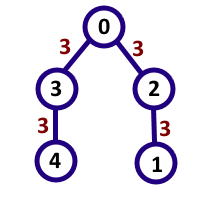
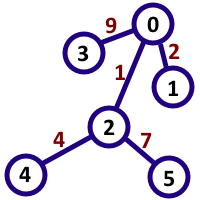
In the first sample case, the interesting pairs are $ (0,4),(1,2),(1,5),(3,2),(2,5),(5,2),(3,5) $. The numbers that are formed by these pairs are $ 14,21,217,91,7,7,917 $ respectively, which are all multiples of $ 7 $. Note that $ (2,5) $ and $ (5,2) $ are considered different.
In the second sample case, the interesting pairs are $ (4,0),(0,4),(3,2),(2,3),(0,1),(1,0),(4,1),(1,4) $, and $ 6 $ of these pairs give the number $ 33 $ while $ 2 $ of them give the number $ 3333 $, which are all multiples of $ 11 $.