CF89B Widget Library
Description
Vasya writes his own library for building graphical user interface. Vasya called his creation VTK (VasyaToolKit). One of the interesting aspects of this library is that widgets are packed in each other.
A widget is some element of graphical interface. Each widget has width and height, and occupies some rectangle on the screen. Any widget in Vasya's library is of type Widget. For simplicity we will identify the widget and its type.
Types HBox and VBox are derivatives of type Widget, so they also are types Widget. Widgets HBox and VBox are special. They can store other widgets. Both those widgets can use the pack() method to pack directly in itself some other widget. Widgets of types HBox and VBox can store several other widgets, even several equal widgets — they will simply appear several times. As a result of using the method pack() only the link to the packed widget is saved, that is when the packed widget is changed, its image in the widget, into which it is packed, will also change.
We shall assume that the widget $ a $ is packed in the widget $ b $ if there exists a chain of widgets $ a=c_{1},c_{2},...,c_{k}=b $ , $ k>=2 $ , for which $ c_{i} $ is packed directly to $ c_{i+1} $ for any $ 1
Input Format
The first line contains an integer $ n $ — the number of instructions ( $ 1
Output Format
For each widget print on a single line its name, width and height, separated by spaces. The lines must be ordered lexicographically by a widget's name.
Please, do not use the %lld specificator to read or write 64-bit integers in C++. It is preferred to use cout stream (also you may use %I64d specificator)
Explanation/Hint
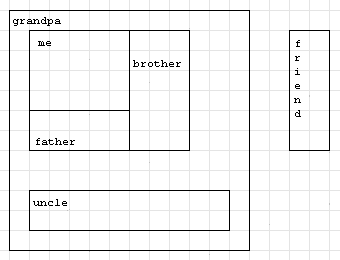
In the first sample the widgets are arranged as follows: