CF903G Yet Another Maxflow Problem
Description
In this problem you will have to deal with a very special network.
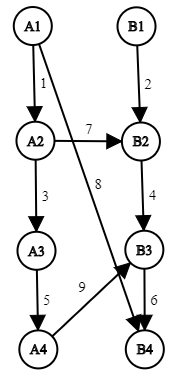
The network consists of two parts: part $ A $ and part $ B $ . Each part consists of $ n $ vertices; $ i $ -th vertex of part $ A $ is denoted as $ A_{i} $ , and $ i $ -th vertex of part $ B $ is denoted as $ B_{i} $ .
For each index $ i $ ( $ 1
Input Format
The first line contains three integer numbers $ n $ , $ m $ and $ q $ ( $ 2
Output Format
Firstly, print the maximum flow value in the original network. Then print $ q $ integers, $ i $ -th of them must be equal to the maximum flow value after $ i $ -th change.
Explanation/Hint
This is the original network in the example: