CF954C Matrix Walk
Description
There is a matrix $ A $ of size $ x×y $ filled with integers. For every ,  $ A_{i,j}=y(i-1)+j $ . Obviously, every integer from $ [1..xy] $ occurs exactly once in this matrix.
You have traversed some path in this matrix. Your path can be described as a sequence of visited cells $ a_{1} $ , $ a_{2} $ , ..., $ a_{n} $ denoting that you started in the cell containing the number $ a_{1} $ , then moved to the cell with the number $ a_{2} $ , and so on.
From the cell located in $ i $ -th line and $ j $ -th column (we denote this cell as $ (i,j) $ ) you can move into one of the following cells:
1. $ (i+1,j) $ — only if $ i<x $ ;
2. $ (i,j+1) $ — only if $ j<y $ ;
3. $ (i-1,j) $ — only if $ i>1 $ ;
4. $ (i,j-1) $ — only if $ j>1 $ .
Notice that making a move requires you to go to an adjacent cell. It is not allowed to stay in the same cell. You don't know $ x $ and $ y $ exactly, but you have to find any possible values for these numbers such that you could start in the cell containing the integer $ a_{1} $ , then move to the cell containing $ a_{2} $ (in one step), then move to the cell containing $ a_{3} $ (also in one step) and so on. Can you choose $ x $ and $ y $ so that they don't contradict with your sequence of moves?
Input Format
The first line contains one integer number $ n $ ( $ 1
Output Format
If all possible values of $ x $ and $ y $ such that $ 1
Explanation/Hint
The matrix and the path on it in the first test looks like this:
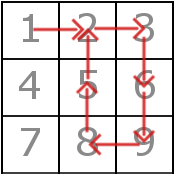Also there exist multiple correct answers for both the first and the third examples.