CF977E Cyclic Components
Description
You are given an undirected graph consisting of $ n $ vertices and $ m $ edges. Your task is to find the number of connected components which are cycles.
Here are some definitions of graph theory.
An undirected graph consists of two sets: set of nodes (called vertices) and set of edges. Each edge connects a pair of vertices. All edges are bidirectional (i.e. if a vertex $ a $ is connected with a vertex $ b $ , a vertex $ b $ is also connected with a vertex $ a $ ). An edge can't connect vertex with itself, there is at most one edge between a pair of vertices.
Two vertices $ u $ and $ v $ belong to the same connected component if and only if there is at least one path along edges connecting $ u $ and $ v $ .
A connected component is a cycle if and only if its vertices can be reordered in such a way that:
- the first vertex is connected with the second vertex by an edge,
- the second vertex is connected with the third vertex by an edge,
- ...
- the last vertex is connected with the first vertex by an edge,
- all the described edges of a cycle are distinct.
A cycle doesn't contain any other edges except described above. By definition any cycle contains three or more vertices.
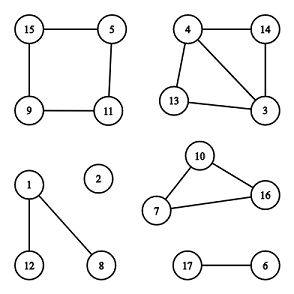There are $ 6 $ connected components, $ 2 $ of them are cycles: $ [7, 10, 16] $ and $ [5, 11, 9, 15] $ .
Input Format
The first line contains two integer numbers $ n $ and $ m $ ( $ 1 \le n \le 2 \cdot 10^5 $ , $ 0 \le m \le 2 \cdot 10^5 $ ) — number of vertices and edges.
The following $ m $ lines contains edges: edge $ i $ is given as a pair of vertices $ v_i $ , $ u_i $ ( $ 1 \le v_i, u_i \le n $ , $ u_i \ne v_i $ ). There is no multiple edges in the given graph, i.e. for each pair ( $ v_i, u_i $ ) there no other pairs ( $ v_i, u_i $ ) and ( $ u_i, v_i $ ) in the list of edges.
Output Format
Print one integer — the number of connected components which are also cycles.
Explanation/Hint
In the first example only component $ [3, 4, 5] $ is also a cycle.
The illustration above corresponds to the second example.