P10789 [NOI2024] Mountain Climbing
Description
"Why climb? Because the mountain is there."
There are $n$ locations on Muztagh Mountain, numbered from $1$ to $n$, where location $1$ is the summit. These $n$ locations form a rooted tree, with node $1$ as the root. For $2\leq i\leq n$, the parent of node $i$ is node $p_i$.
Let $d_i$ be the number of edges on the path from node $i$ to the summit. Formally, $d_1=0$, and for $2\leq i\leq n$, $d_i=d_{p_i}+1$.
A **climbing path** is a plan that starts from some node among $2\sim n$, and after several **moves**, **reaches the summit**.
A **move** starting from node $i(2\leq i\leq n)$ is one of the following two types:
1. Sprint: within the given sprint range $[l_i,r_i]$, choose a positive integer $k$ such that $l_i\leq k\leq r_i$, and move $k$ steps toward the summit, i.e. move to the $k$-th ancestor of node $i$ in the rooted tree. It is guaranteed that $1\leq l_i\leq r_i\leq d_i$.
2. Rest: because the terrain of Muztagh Mountain is steep, when resting you will slip down to one of its children. Formally, choose a node $j$ such that $p_j=i$, and move to node $j$. In particular, if node $i$ is a leaf in the rooted tree, then there is no $j$ satisfying $p_j=i$, so you cannot choose Rest in this case.
The **climbing sequence** corresponding to a **climbing path** is the sequence consisting of the starting node and every node reached after each move. Formally, the **climbing sequence** corresponding to a **climbing path** starting from node $x$ is a node sequence $a_1=x,a_2,\dots,a_m=1$ such that for $1\leq i
Input Format
**This problem contains multiple test cases.**
The first line contains an integer $c$, indicating the test point ID. $c=0$ means this test point is the sample.
The second line contains an integer $t$, the number of test cases.
Then each test case is given as follows:
The first line contains an integer $n$, the number of locations on Muztagh Mountain.
The next $n-1$ lines: the $(i-1)$-th line ($2\leq i\leq n$) contains four integers $p_i,l_i,r_i,h_i$. It is guaranteed that $1\leq p_i
Output Format
For each test case, output one line with $n-1$ integers, where the $i$-th integer is the number of ways (modulo $998\,244\,353$) to reach the summit starting from node $i+1$ (i.e. nodes $2\sim n$).
Explanation/Hint
**[Sample 1 Explanation]**
Sample $1$ contains three test cases.
For the first test case, the structure of locations on Muztagh Mountain is as follows:
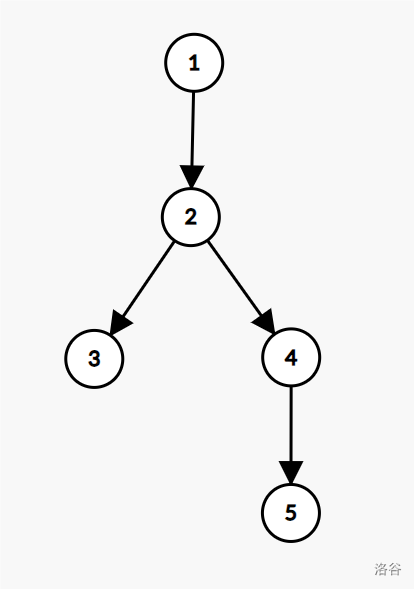
In this test case, $d_1=0$, $d_2=1$, $d_3=d_4=2$, $d_5=3$.
There are $2$ legal climbing paths starting from $4$:
1. Sprint directly to the 2-nd ancestor of $4$, i.e. $1$, reaching the summit. The corresponding climbing sequence is $[4,1]$.
2. Rest first and slip down to $5$, then sprint from $5$ to its 3-rd ancestor, reaching the summit. The corresponding climbing sequence is $[4,5,1]$.
There are $4$ legal climbing paths starting from $5$:
1. Sprint directly to the 3-rd ancestor of $5$, i.e. $1$, reaching the summit. The corresponding climbing sequence is $[5,1]$.
2. Sprint first to the 2-nd ancestor of $5$, i.e. $2$; then sprint from $2$ to its 1-st ancestor, reaching the summit. The corresponding climbing sequence is $[5,2,1]$.
3. Sprint first to the 2-nd ancestor of $5$, i.e. $2$; then rest at $2$ and slip down to $4$; then sprint from $4$ to its 2-nd ancestor, reaching the summit. The corresponding climbing sequence is $[5,2,4,1]$.
4. Sprint first to the 2-nd ancestor of $5$, i.e. $2$; then rest at $2$ and slip down to $4$; keep resting and slip down to $5$; then sprint again from $5$ to its 3-rd ancestor, reaching the summit. The corresponding climbing sequence is $[5,2,4,5,1]$.
**[Constraints]**
For all test cases, it is guaranteed that: $1\leq t\leq 4$, $2\leq n\leq 10^5$.
For any $2\leq i\leq n$, it is guaranteed that: $1\leq p_i