P1203 [IOI 1993 / USACO1.1] Broken Necklace
Description
You have a necklace of $N$ red, white, or blue beads ($3 \le N \le 350$), some of which are red, others blue, and others white, arranged at random. Here are two examples for $n=29$.
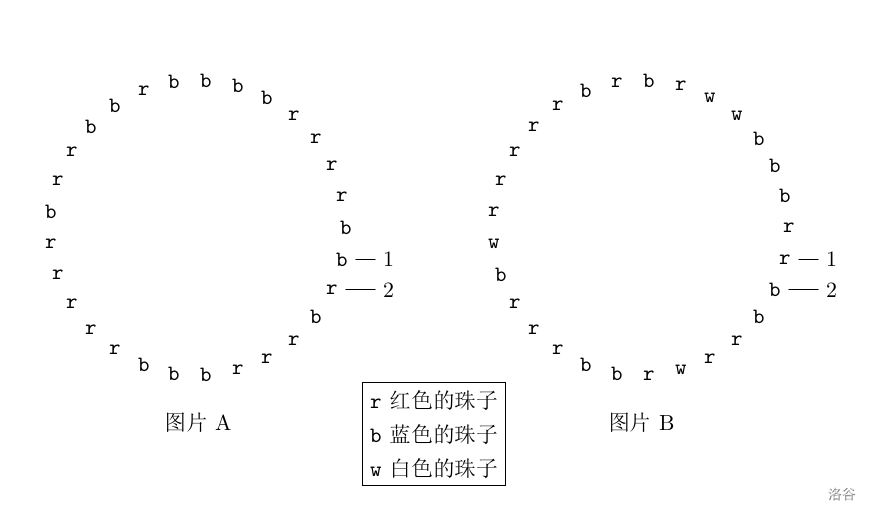
The beads considered first and second in the text that follows have been marked in the picture.
The configuration in Figure A may be represented as a string of `b`'s and `r`'s, where `b` represents a blue bead and `r` represents a red one, as follows:
```
brbrrrbbbrrrrrbrrbbrbbbbrrrrb
```
Suppose you are to break the necklace at some point, lay it out straight, and then collect beads of the same color from one end until you reach a bead of a different color, and do the same for the other end. The two ends might not be of the same color as the beads collected before this.
Determine the point where the necklace should be broken so that the most number of beads can be collected. No bead can be collected more than once.
### Example
For example, for the necklace in Figure A, $8$ beads can be collected, with the breaking point either between bead $9$ and bead $10$ or else between bead $24$ and bead $25$.
In some necklaces, white beads had been included as shown in Figure B above. When collecting beads, a white bead that is encountered may be treated as either red or blue and then painted with the desired color. The string that represents this configuration can include any of the three symbols `r`, `b` and `w`.
Write a program to determine the largest number of beads that can be collected from a supplied necklace.
Input Format
- Line 1: $N$, the number of beads.
- Line 2: a string of $N$ characters, each of which is `r`, `b`, or `w`.
Output Format
A single line containing the maximum number of beads that can be collected from the supplied necklace.
Explanation/Hint
## Output Explanation
Consider two copies of the beads (kind of like being able to run around the ends). The string of $11$ is marked.
```
Two necklace copies joined here
v
wwwbbrwrbrbrrbrbrwrwwrbwrwrrb|wwwbbrwrbrbrrbrbrwrwwrbwrwrrb
******|*****
rrrrrb|bbbbb