P13279 Growing Tree
Description
You are Little J's gardener, and you need to help him prune his growing tree, $T_1$.
$T_1$ is a $k$-ary tree. At time 0, $T_1$ consists of only the root node with ID 1.
Starting from time 1, at each time step, the following events occur in order:
- **Growth Phase**: For all nodes in $T_1$ that have fewer than $k$ children, new child nodes are added until they have exactly $k$ children. The IDs of these new nodes can be arbitrarily assigned (they don't need to be $\le n$), but must be unique within $T_1$.
- **Pruning Phase**: You may perform any number of operations (including zero), where each operation consists of selecting any non-root node of $T_1$ and removing its entire subtree.
Little J provides you with a tree $T_2$ of $n$ nodes (rooted at node 1). The goal is to satisfy the following conditions after some time:
- $T_1$ must have exactly $n$ nodes with IDs exactly 1 through $n$.
- For all non-root nodes, nodes with the same ID in $T_1$ and $T_2$ must have the same parent.
Your task is to determine:
- The earliest time $p$ when these conditions can be satisfied.
- The minimum number of pruning operations $q$ required at that time.
Input Format
First line: Two integers $n$ and $k$.
Next $n-1$ lines: Pairs $(u,v)$ describing edges of $T_2$.
Output Format
Two space-separated integers $p$ $q$:
1. Earliest possible time $p$ to satisfy conditions.
2. Minimum operations $q$ needed at time $p$.
Explanation/Hint
**Sample Explanation:**
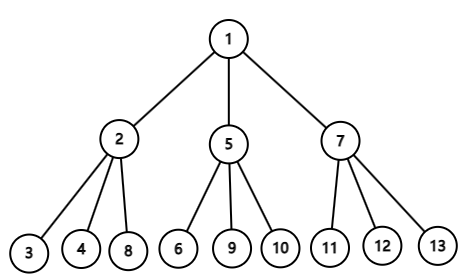
As shown in the figure, after assigning node IDs at times $1$ and $2$, and then deleting subtrees of nodes $7,8,9,10$ at time $2$, the conditions are satisfied. It can be proven that no better solution exists.
**Data Range**
**This problem uses bundled testing:**
- Subtask#1 ($10\ \text{pts}$): $k=1$.
- Subtask#2 ($10\ \text{pts}$): $T_2$ is a perfect $k$-ary tree.(That means every non-leaf nodes have $k$ children.)
- Subtask#3 ($20\ \text{pts}$): $n,k≤10$.
- Subtask#4 ($20\ \text{pts}$): $k=2$.
- Subtask#5 ($40\ \text{pts}$): No additional constraints.
For all data $1\le u,v\le n\le5\times10^5$, $1\le k\le10^6$, $\max\limits_{1\le i\le n}\{son_i\}\le k$. Here, $son_i$ refers to the **number of sons** of the $i$-th node in $T_2$.