P13678 [GCPC 2023] Mischievous Math
Description
Max enjoys playing number games, whether it involves finding
a combination that leads to a given
result or discovering all possible results for some given integers.
The problem is that Max is only 10 and has limited
mathematical knowledge, which restricts the possibilities for these games.
Luckily, in today's maths class, Max learned the concept of
parentheses and their effects on calculations. He realises that incorporating parentheses
into his number games could make them much more interesting.
After getting home from school, he asked his sister Nina to play a
variant of his favourite number game with him, using parentheses.
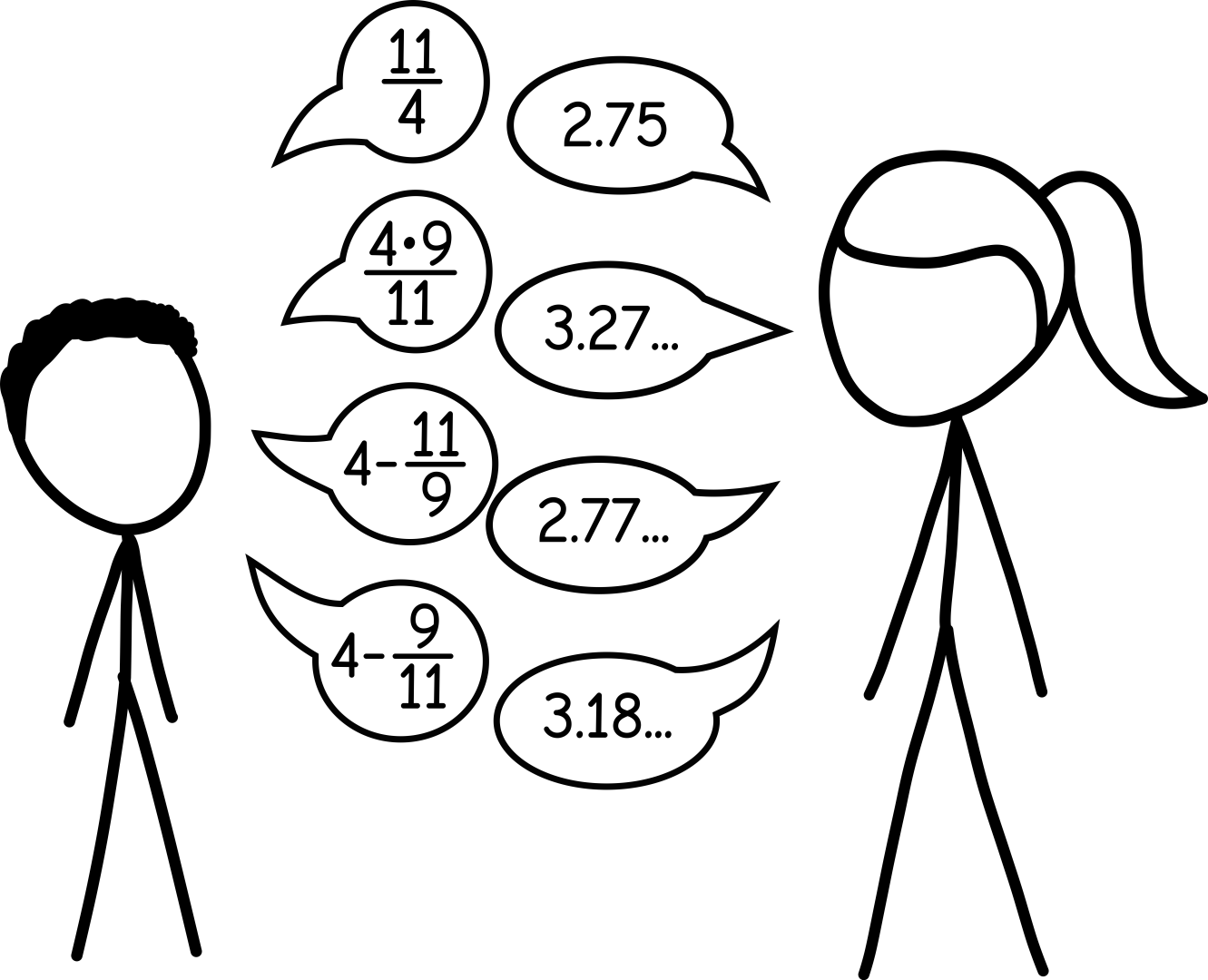
:::align{center}
Max trying to solve the third sample.
:::
In this new game, Max first tells her a number $d$.
Nina then tells him three numbers $a$, $b$ and $c$.
Now, Max needs to find an arithmetic expression
using addition, subtraction, multiplication and division, using each of these three
numbers ($a$, $b$ and $c$) at most once, such that the result is equal to $d$.
The numbers $a, b, c$ and $d$ all have to be distinct, and Max is allowed to
use parentheses as well.
For instance, for $a = 5$, $b = 8$, $c = 17$ and $d = 96$ a possible
solution would be $(17 - 5) \times 8 = 96$, and for $a = 3$, $b = 7$, $c = 84$
and $d = 12$ a possible solution would be $84 \div 7 = 12$, without using
the $3$.
Nina is quickly annoyed by this game. She would rather spend the
afternoon with her friends instead of playing games with her little
brother. Therefore, she wants to give him a task that occupies him for as long as possible.
Help her to find three numbers $a$, $b$ and $c$
such that it is impossible for Max to come up with a solution.
Input Format
The input consists of:
- One line with an integer $d$ ($1 \le d \le 100$), Max's chosen number.
Output Format
Output three numbers $a$, $b$ and $c$ ($1 \le a,b,c \le 100$) such that the numbers $a$, $b$, $c$ and $d$ are pairwise distinct and there is no solution to the number game.