P14852 [ICPC 2022 Yokohama R] New Year Festival
Description
The ICPC (Incredibly Colossal and Particularly Comfortable) Theater is giving a number of traditional events to celebrate the New Year!
Each of the events has its own unalterable duration. Start times of the events are flexible as long as no two events overlap. An event may start immediately after another event ends.
Start times of the events influence the costs. The cost of an event is given by a continuous piecewise linear function (a polygonal line function) of its start time. Different events may have different cost functions.
You are asked to schedule all the events minimizing the total cost.
Input Format
The input consists of a single test case of the following format.
$$
\begin{aligned}
&n \\
&\text{Description}_1 \\
&\vdots \\
&\text{Description}_n
\end{aligned}
$$
The first line contains an integer $n$, representing the number of events. $2 \leq n \leq 11$ holds. The descriptions of the events follow. The description of the $i$-th event, $\text{Description}_i$ ($1 \leq i \leq n$), has the following format.
$$
\begin{aligned}
&m \ l \\
&x_1 \ y_1 \\
&\vdots \\
&x_m \ y_m
\end{aligned}
$$
The integer $m$ in the first line is the number of vertices of the cost function of the event. The integer $l$ in the same line is the duration of the event. $1 \leq m \leq 60$ and $1 \leq l \leq 10^8$ hold.
The following $m$ lines describe the cost function. The $j$-th line of the $m$ lines consists of the two integers $x_j$ and $y_j$ specifying the $j$-th vertex of the cost function. $0 \leq x_1 < \cdots < x_m \leq 10^8$ and $0 \leq y_j \leq 10^8$ hold. In addition, $(y_{j+1} - y_j)/(x_{j+1} - x_j)$ is an integer for any $1 \leq j < m$.
The start time $t$ of the event must satisfy $x_1 \leq t \leq x_m$. For $j$ ($1 \leq j < m$) satisfying $x_j \leq t \leq x_{j+1}$, the cost of the event is given as $y_j + (t - x_j) \times (y_{j+1} - y_j)/(x_{j+1} - x_j)$.
The total number of the vertices of all the cost functions is not greater than 60.
Output Format
Output the minimum possible total cost of the events in a line.
It is guaranteed that there is at least one possible schedule containing no overlap. It can be proved that the answer is an integer.
Explanation/Hint
For Sample Input 1, making the (start time, end time) pairs of the three events to be $(330, 380)$, $(380, 500)$, and $(170, 330)$, respectively, achieves the minimum total cost without event overlaps. The cost of the event 1 is $2500 + (330 - 300) \times (0 - 2500)/(350 - 300) = 1000$. Similarly, the costs of the events 2 and 3 are 0 and 460, respectively.
For Sample Input 2, the minimum cost is achieved by $(384, 544)$, $(104, 384)$, $(544, 704)$, and $(720, 960)$ for the four events.
:::align{center}
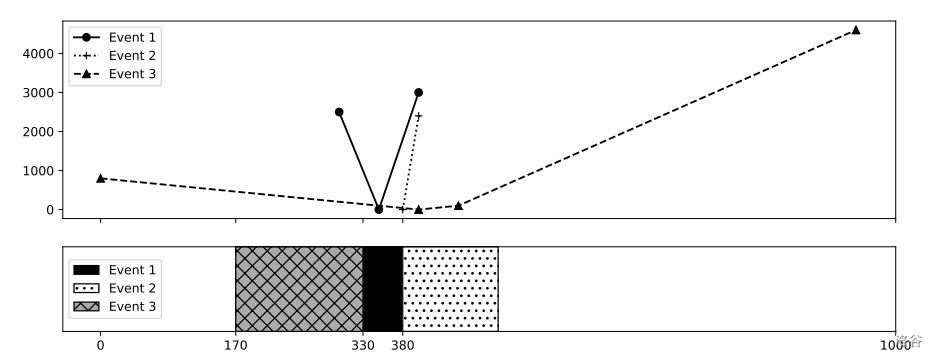
Figure K.1. Cost functions in Sample Input 1 and a sample schedule
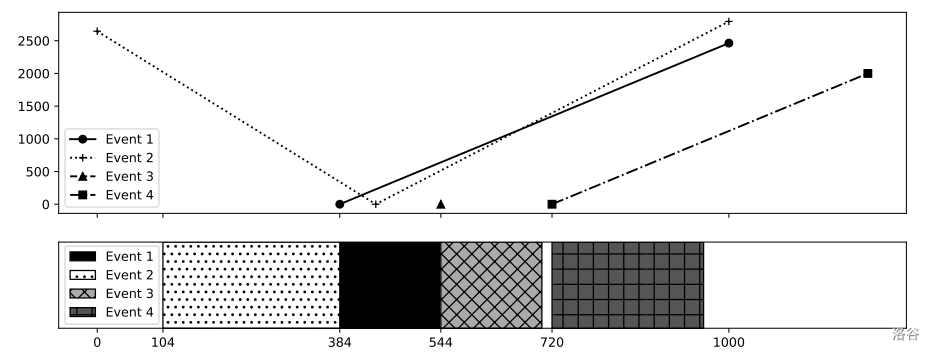
Figure K.2. Cost functions in Sample Input 2 and a sample schedule
:::
In Figures K.1 and K.2, polylines in the top figure represent cost functions, and rectangles in the bottom figure represent event durations of a schedule achieving the minimum total cost.