P15401 [NOISG 2026 Prelim] Airplane 2
Description
After NOI 2023, Pan the Monkey has taken over control of an airplane from Benson the Rabbit. In the airplane, the passenger seats are arranged in $h$ rows and $w$ columns. The rows are numbered 1 to $h$ from top to bottom, and the columns are numbered 1 to $w$ from left to right. We refer to the seat located at row $i$ and column $j$ as $(i, j)$.
CEO Pan sells airplane tickets to $k$ passengers, who are numbered from 1 to $k$. The $i$-th passenger has a preferred column $c[i]$, but Pan may assign any row $r[i]$ for them to sit in. No two passengers may occupy the same seat.
To maintain an even weight distribution in the airplane, a passenger in an earlier row must not be seated in a later column. Formally, for any two assigned seats $(a_1, b_1)$ and $(a_2, b_2)$, if $a_1 < a_2$ then $b_1 \le b_2$.
CEO Pan defines the **Gross Passenger Satisfaction** as the **minimum** Manhattan distance between all pairs of assigned seats. The Manhattan distance between a pair of seats $(a_1, b_1)$ and $(a_2, b_2)$ is $|a_1 - a_2| + |b_1 - b_2|$, where $|x|$ is the absolute value of $x$.
Help Pan determine the **maximum** possible Gross Passenger Satisfaction over all valid assignments of rows, or determine that there is no valid assignment of rows.
Input Format
Your program must read from standard input.
The first line of input contains three space-separated integers $h$, $w$, and $k$.
The second line of input contains $k$ space-separated integers $c[1], c[2], \ldots, c[k]$.
Output Format
Your program must print to standard output.
Output one integer, the maximum Gross Passenger Satisfaction. If there is no valid assignment of rows, output $-1$.
Explanation/Hint
### Sample Test Case 1 Explanation
The airplane has $h = 5$ rows and $w = 1$ column. There are a total of $5 \times 1 = 5$ seats onboard. Therefore, it is impossible for Pan to assign unique seats for $k = 6$ passengers.
### Sample Test Case 5 Explanation
:::align{center}
:::
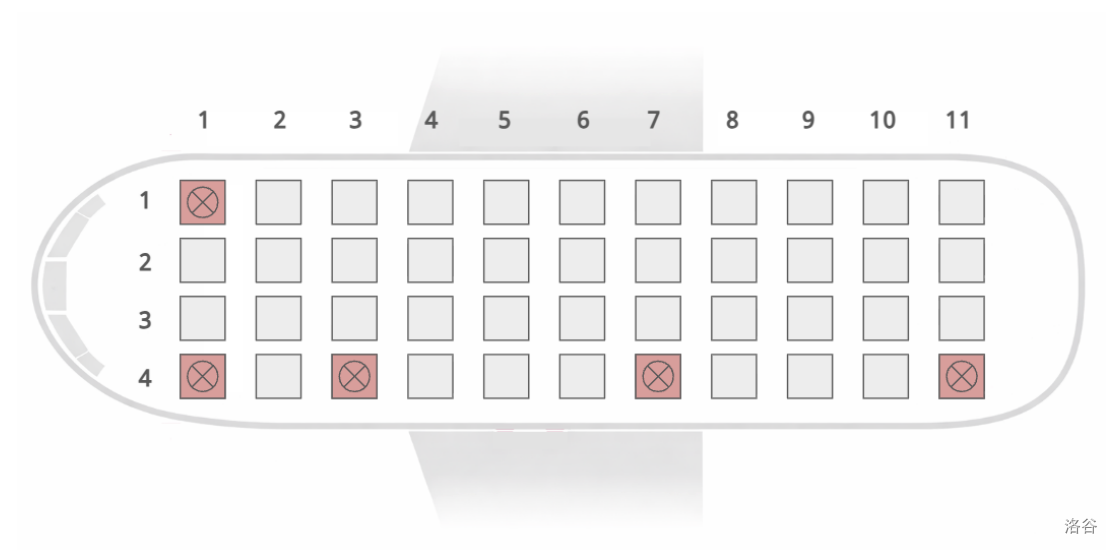
One such valid assignment of rows that maximises the **Gross Passenger Satisfaction** is shown in the figure above. Each crossed grid indicates that the seat is assigned to a passenger. The first passenger is assigned to row 1, while the rest of the passengers are assigned to row 4.
The Manhattan distance between passengers 2 (seat $(4, 1)$) and 5 (seat $(4, 3)$) is $|4 - 4| + |1 - 3| = 2$ which is the minimum among all pairs of passengers. Hence, the **Gross Passenger Satisfaction** of this assignment is 2.
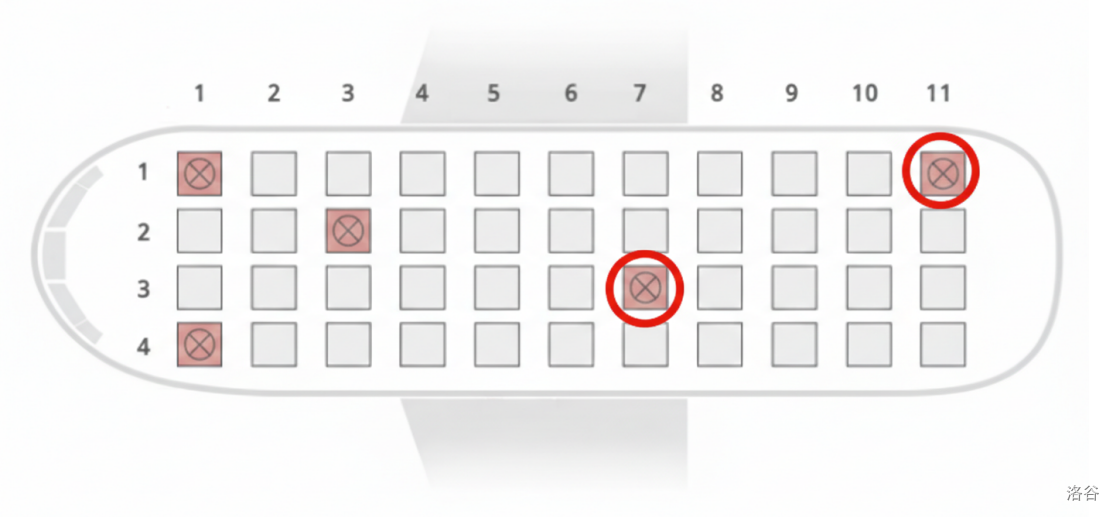
The figure below shows an example of an **invalid** assignment of rows. Although the **Gross Passenger Satisfaction** in this assignment is 3, passengers 3 (seat $(1, 11)$) and 4 (seat $(3, 7)$) would cause an uneven weight distribution since passenger 3 sits in an earlier row but in a later column than passenger 4.
:::align{center}
:::
### Subtasks
For all test cases, the input will satisfy the following bounds:
- $1 \le h, w \le 10^9$
- $2 \le k \le 200\,000$
- $1 \le c[i] \le w$ for all $1 \le i \le k$
Your program will be tested on input instances that satisfy the following restrictions:
| Subtask | Score | Additional Constraints |
|:-------:|:-----:|:-------------------------------------------:|
| 0 | 0 | Sample test cases |
| 1 | 5 | $w = 1$ |
| 2 | 5 | $c[i] = i$ for all $1 \le i \le k$ |
| 3 | 7 | $c$ is an arithmetic sequence. $(c[i+1] - c[i] = c[i] - c[i-1])$ for all $2 \le i \le k-1$ |
| 4 | 9 | $h, w, k \le 8$ |
| 5 | 31 | $h, w, k \le 3000$ |
| 6 | 16 | $c[i] \ne c[j]$ for all $1 \le i < j \le k$ |
| 7 | 27 | No additional constraints |