P15487 [IOI 1998] Camelot
Description
Centuries ago, King Arthur and the Knights of
the Round Table used to meet every year on
New Year's Day to celebrate their fellowship.
In remembrance of these events, we consider a
board game for one player, on which one king
and several knight pieces are placed at random
on distinct squares.
The **Board** is an $8\times8$ array of squares.
:::align{center}
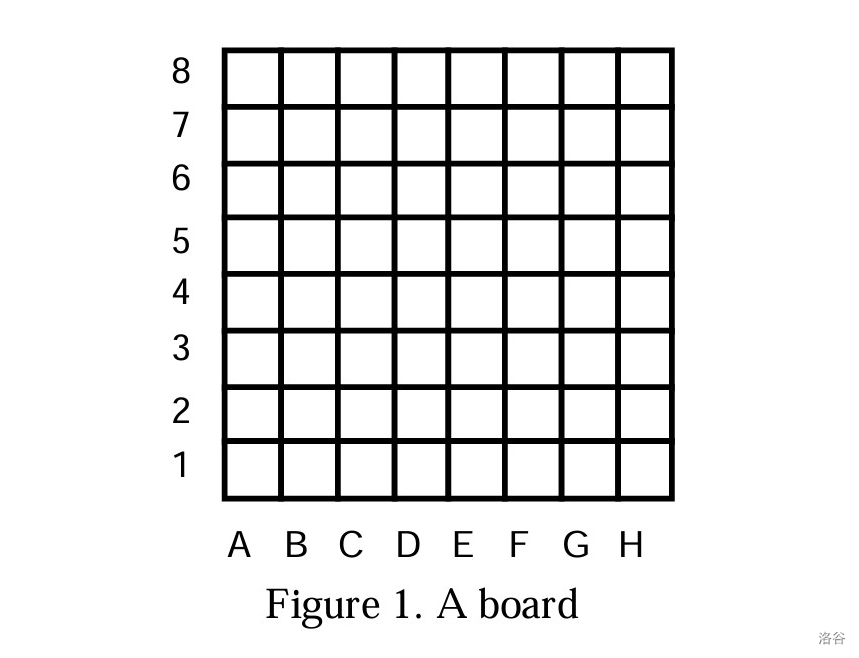
:::
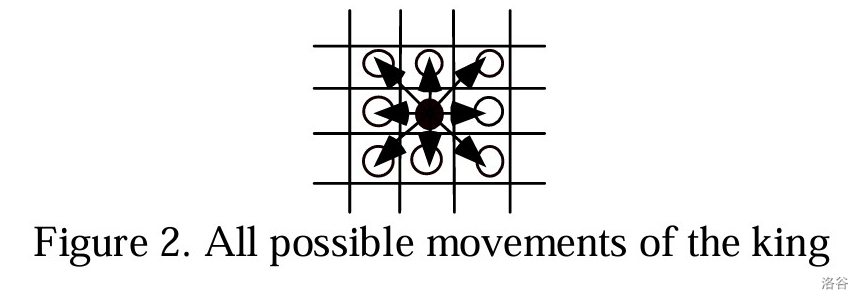
The **King** can move to any adjacent square
from $\bullet$ to $\circ$, as shown in Figure 2, as long as it
does not fall off the board.
:::align{center}
:::
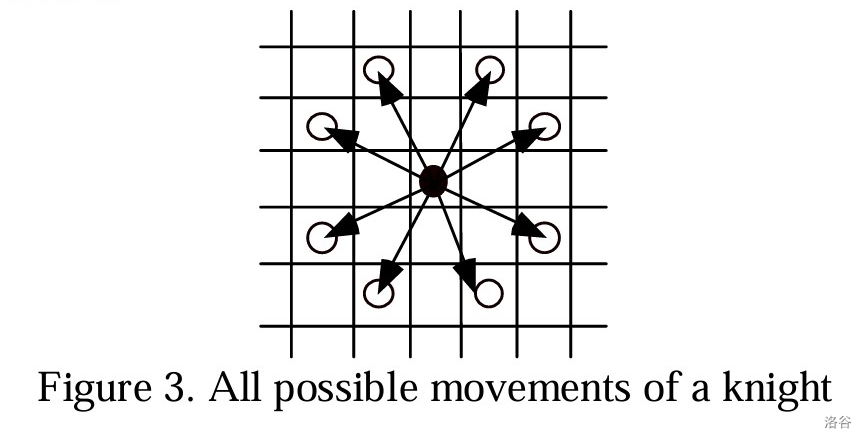
A **Knight** can jump from $\bullet$ to $\circ$, as shown in
Figure 3, as long as it does not fall off the
board.
:::align{center}
:::
During the play, the player can place more than
one piece in the same square. The board
squares are assumed big enough so that a piece
is never an obstacle for other piece to move
freely.
The player's goal is to move the pieces so as to
gather them all in the same square, in the
smallest possible number of moves. To achieve
this, he must move the pieces as prescribed
above. Additionally, whenever the king and one
or more knights are placed in the same square,
the player may choose to move the king and
one of the knights together henceforth, as a
single knight, up to the final gathering point.
Moving the knight together with the king
counts as a single move.
### Task
Write a program to compute the minimum
number of moves the player must perform to
produce the gathering.
Input Format
Contains the initial
board configuration, encoded as a character
string. The string contains a sequence of up to
$64$ distinct board positions, being the first one
the position of the king and the remaining ones
those of the knights. Each position is a letter
digit pair. The letter indicates the horizontal
board coordinate, the digit indicates the vertical
board coordinate.
Output Format
Must contain a
single line with an integer indicating the
minimum number of moves the player must
perform to produce the gathering.
Explanation/Hint
$0 \le$ number of knights $\le 63$