P15564 [CCPC 2025 Harbin Site] Connected Equilateral Triangles
Description
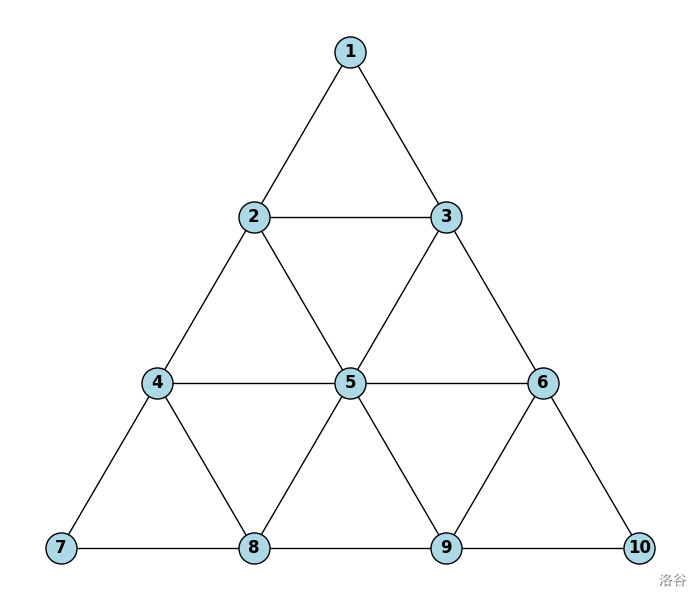
Town A has $\frac{(n+1)(n+2)}{2}$ intersections. These intersections are connected by $3n$ **paths**, forming an equilateral triangle whose side length contains **$n$ roads**. The case $n=3$ is shown in the figure below.
:::align{center}
:::
These $3n$ **paths** can be divided into three directions: left-slanted, horizontal, and right-slanted. Each direction contains $n$ **paths**. In each direction, the $i$-th **path** consists of $i$ **roads**.
For example, when $n=3$:
- The left-slanted **paths**, ordered by the number of **roads** from small to large, are $(6\leftrightarrow9)$, $(3\leftrightarrow5\leftrightarrow8)$, $(1\leftrightarrow2\leftrightarrow4\leftrightarrow7)$.
- The horizontal **paths**, ordered by the number of **roads** from small to large, are $(2\leftrightarrow3)$, $(4\leftrightarrow5\leftrightarrow6)$, $(7\leftrightarrow8\leftrightarrow9\leftrightarrow10)$.
- The right-slanted **paths**, ordered by the number of **roads** from small to large, are $(4\leftrightarrow8)$, $(2\leftrightarrow5\leftrightarrow9)$, $(1\leftrightarrow3\leftrightarrow6\leftrightarrow10)$.
We call three **distinct** intersections $(u,v,w)$ an “equilateral triangle” triple of positive integer length $l$ if and only if, after **arbitrarily reordering $u,v,w$**, one of the following holds:
- Starting from $u$, go through $l$ left-slanted **roads** to reach $v$;
- Starting from $v$, go through $l$ horizontal **roads** to reach $w$;
- Starting from $w$, go through $l$ right-slanted **roads** to reach $u$.
Or:
- Starting from $u$, go through $l$ right-slanted **roads** to reach $v$;
- Starting from $v$, go through $l$ horizontal **roads** to reach $w$;
- Starting from $w$, go through $l$ left-slanted **roads** to reach $u$.
For example, in the figure above, $(2,4,5)$ and $(2,3,5)$ are “equilateral triangle” triples, while $(2,3,4)$ is not.
To reduce traffic congestion, Town A decides to assign a direction to every **road**. After directing the roads, each **road** has a unique fixed direction, and all **roads** on the same **path** share the same direction.
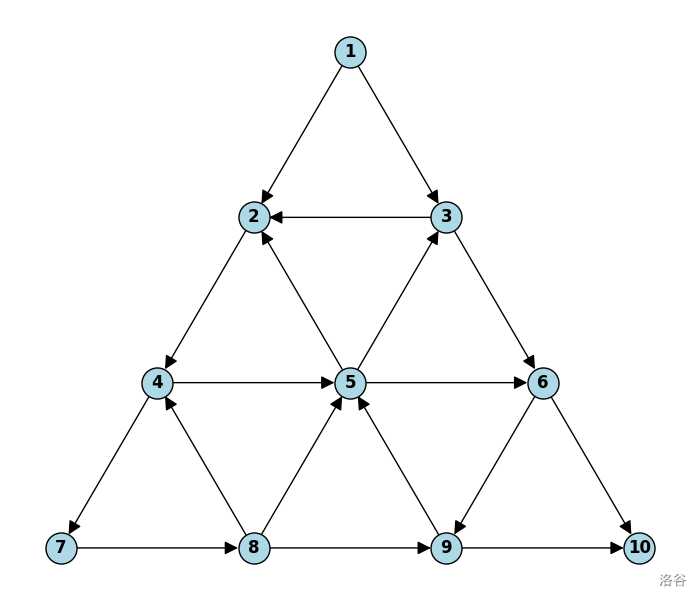
The figure below shows one possible orientation (corresponding to the third test case of Sample 1).
:::align{center}
:::
We call three distinct intersections $(u,v,w)$ a “connected equilateral triangle” triple if and only if they form an “equilateral triangle” triple of positive integer length $l$ in the graph, and they can reach each other using only the $3l$ **roads** that form this “equilateral triangle” triple. For example, in the figure above:
- $(2, 4, 5)$ is a “connected equilateral triangle” triple, because it is not only an “equilateral triangle” triple, but also they can reach each other using only the **roads** of that triangle $(2 \rightarrow 4,4 \rightarrow 5, 5 \rightarrow 2)$.
- $(2, 3, 4)$ is not a “connected equilateral triangle” triple, because it is not an “equilateral triangle” triple.
- $(2, 3, 5)$ is not a “connected equilateral triangle” triple, because although it is an “equilateral triangle” triple, they cannot reach each other using only the **roads** of that triangle $(5 \rightarrow 3, 3 \rightarrow 2, 2 \leftarrow 5)$.
Now you are given the directions of all directed **paths**. Ask how many “connected equilateral triangle” triples there are in this graph.
Input Format
This problem contains multiple test cases. The first line contains an integer $T$ ($1 \le T \le 10^5$), indicating the number of test cases.
Then the test cases follow. For each test case:
The first line contains an integer $n$ ($1 \le n \le 10^5$), indicating the size of the equilateral triangle.
The second line contains a string $s1$ of length $n$, where $s1_i \in \{\text{0, 1}\}$. If $s1_i=\text{0}$, it means the direction of the left-slanted **path** consisting of $i$ **roads** is from upper-right to lower-left, and vice versa.
The third line contains a string $s2$ of length $n$, where $s2_i \in \{\text{0, 1}\}$. If $s2_i=\text{0}$, it means the direction of the horizontal **path** consisting of $i$ **roads** is from left to right, and vice versa.
The fourth line contains a string $s3$ of length $n$, where $s3_i \in \{\text{0, 1}\}$. If $s3_i=\text{0}$, it means the direction of the right-slanted **path** consisting of $i$ **roads** is from lower-right to upper-left, and vice versa.
It is guaranteed that the sum of $n$ over all test cases does not exceed $10^5$.
Output Format
For each test case, output one integer, representing the number of “connected equilateral triangle” triples.
Explanation/Hint
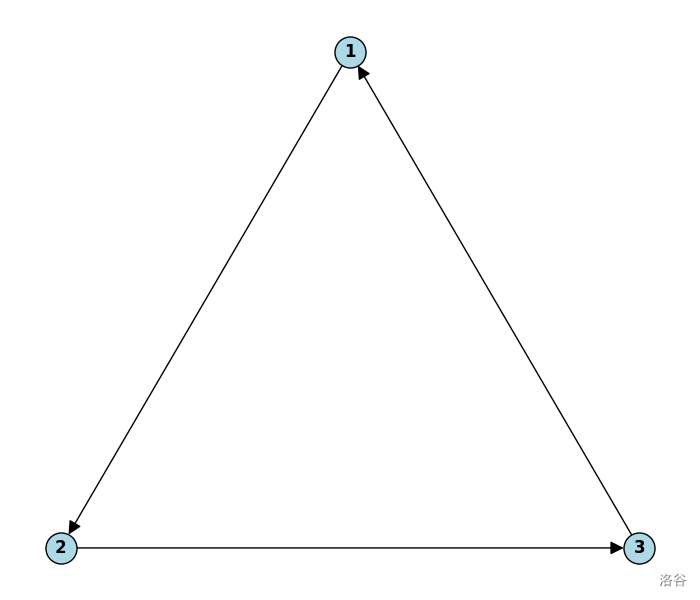
In Sample 1, the graph of the first test case is shown below.
:::align{center}
:::
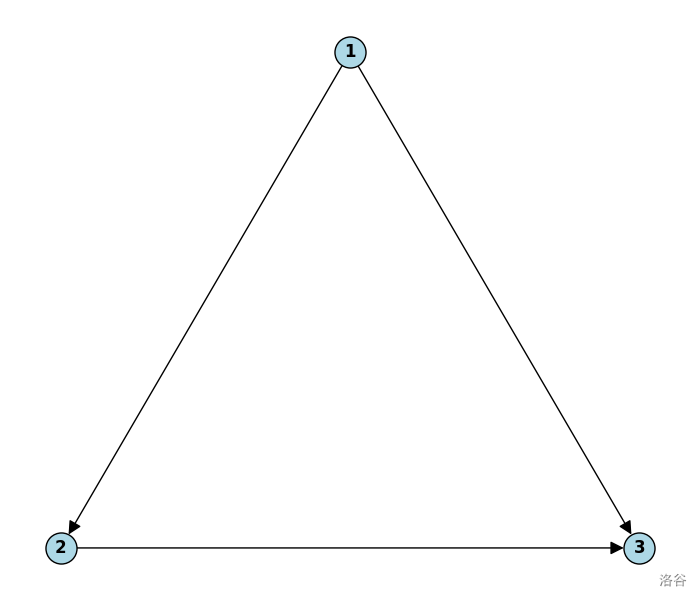
In Sample 1, the graph of the second test case is shown below.
:::align{center}
:::
In Sample 1, the “connected equilateral triangle” triples in the third test case are:
- $(2, 4, 5)$;
- $(4, 7, 8)$;
- $(5, 6, 9)$;
- $(2, 7, 9)$.
Translated by ChatGPT 5