P15820 [JOI 2015 Final] City Wall / Rampart
Description
As a historian, Professor JOI is studying the IOI Kingdom that once existed.
According to past research, the IOI Kingdom is a rectangular area divided into a grid with $H$ rows and $W$ columns. The capital of the IOI Kingdom was surrounded by walls used for defense.
The walls surrounding the capital have the following shape. A wall has a value called its "size". A wall of size $s$ ($s \ge 3$) means the frame part that remains after removing an inner $(s-2) \times (s-2)$ square region from an $s \times s$ square region.
The investigation shows that the size of the wall surrounding the capital is at least $L$. In addition, it is known that there are some cells in the IOI Kingdom where there is **no** wall.
For further study, Professor JOI wants to know how many different walls are possible.
### Task
Given the size of the IOI Kingdom, the minimum wall size, and the information about cells that are known to have no wall, write a program to compute how many walls are possible.
Input Format
Read the following data from standard input.
* The first line contains four space-separated integers $H, W, L, P$. This means the IOI Kingdom is a rectangular area with $H$ rows and $W$ columns, the wall size is at least $L$, and it is known that there are $P$ cells where no wall exists.
* In the next $P$ lines, the $i$-th line ($1 \le i \le P$) contains two space-separated integers $A_i, B_i$. This means it is known that the cell at row $A_i$ from top to bottom and column $B_i$ from left to right in the IOI Kingdom has no wall.
Output Format
Output one line to standard output containing one integer, which is the number of possible walls.
Explanation/Hint
### Sample Explanation 1
In this sample, there are 4 possible walls as follows. The cells marked with × are the cells that are known to have no wall.
:::align{center}
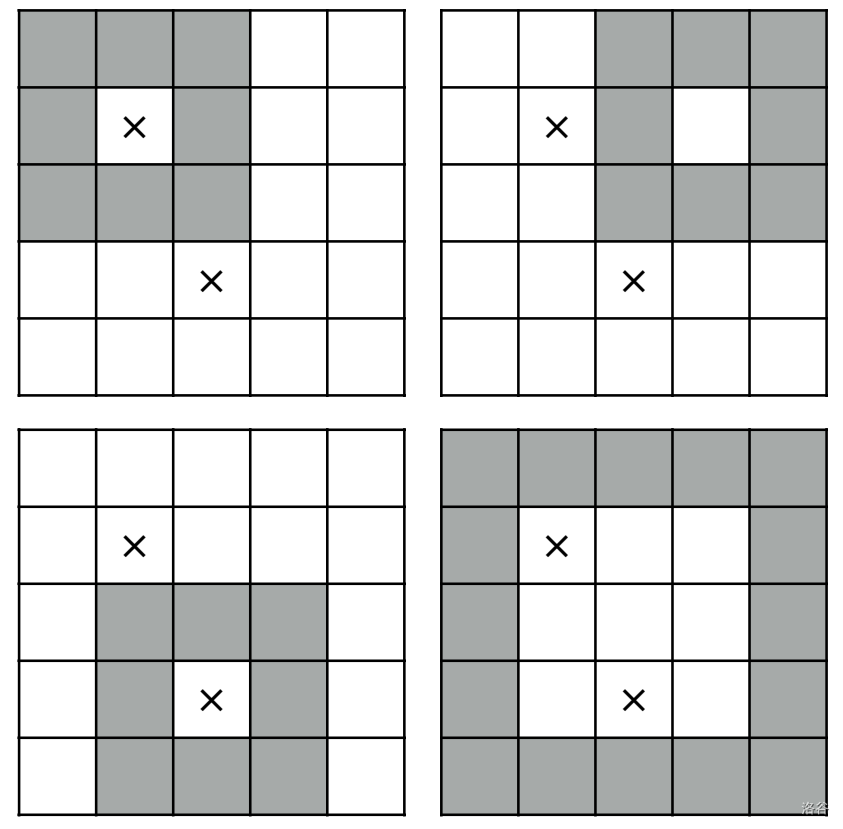
:::
### Constraints
All input data satisfy the following conditions:
* $1 \le H \le 4000$.
* $1 \le W \le 4000$.
* $3 \le L \le H$ and $3 \le L \le W$.
* $0 \le P \le 100000$.
* $1 \le A_i \le H$ ($1 \le i \le P$).
* $1 \le B_i \le W$ ($1 \le i \le P$).
* $(A_i, B_i) \ne (A_j, B_j)$ ($1 \le i < j \le P$). (That is, the positions of the cells known to have no wall are all distinct.)
### Subtasks
#### Subtask 1 [4 points]
Satisfies the following conditions:
* $H \le 500$.
* $W \le 500$.
#### Subtask 2 [16 points]
* Satisfies $0 \le P \le 10$.
#### Subtask 3 [80 points]
No additional constraints.
Translated by DeepSeek V3.2.
Translated by ChatGPT 5