P16470 [GKS 2013 #A] Rational Number Tree
Description
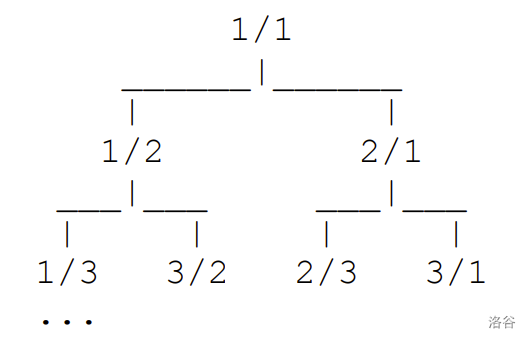
Consider an infinite complete binary tree where the root node is $1/1$ and left and right childs of node $p/q$ are $p/(p+q)$ and $(p+q)/q$, respectively. This tree looks like:
:::align{center}
:::
It is known that every positive rational number appears exactly once in this tree. A level-order traversal of the tree results in the following array:
$1/1$, $1/2$, $2/1$, $1/3$, $3/2$, $2/3$, $3/1$, $\dots$
Please solve the following two questions:
1. Find the $n$-th element of the array, where $n$ starts from $1$. For example, for the input $2$, the correct output is $1/2$.
2. Given $p/q$, find its position in the array. As an example, the input $1/2$ results in the output $2$.
Input Format
The first line of the input gives the number of test cases, $T$. $T$ test cases follow. Each test case consists of one line. The line contains a problem id ($1$ or $2$) and one or two additional integers:
1. If the problem id is $1$, then only one integer $n$ is given, and you are expected to find the $n$-th element of the array.
2. If the problem id is $2$, then two integers $p$ and $q$ are given, and you are expected to find the position of $p/q$ in the array.
Output Format
For each test case:
1. If the problem id is $1$, then output one line containing "Case #x: p q", where $x$ is the case number (starting from $1$), and $p, q$ are numerator and denominator of the asked array element, respectively.
2. If the problem id is $2$, then output one line containing "Case #x: n", where $x$ is the case number (starting from $1$), and $n$ is the position of the given number.
Explanation/Hint
### Limits
$1 \le T \le 100$; $p$ and $q$ are relatively prime.
**Test set 1 - Visible**
$1 \le n, p, q \le 2^{16}-1$; $p/q$ is an element in a tree with level number $\le 16$.
**Test set 2 - Hidden**
$1 \le n, p, q \le 2^{64}-1$; $p/q$ is an element in a tree with level number $\le 64$.