P16478 [GKS 2014 #A] Super 2048
Description
$2048$ is a famous single-player game in which the objective is to slide tiles on a grid to combine them and create a tile with the number $2048$.
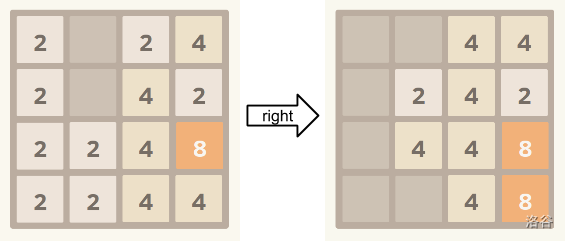
$2048$ is played on a simple $4 \times 4$ grid with tiles that slide smoothly when a player moves them. For each movement, the player can choose to move all tiles in $4$ directions, left, right, up, and down, as far as possible at the same time. If two tiles of the same number collide while moving, they will merge into a tile with the total value of the two tiles that collided. **In one movement, one newly created tile can not be merged again and always is merged with the tile next to it along the moving direction first.** E.g. if the three "2" are in a row "2 2 2" and the player choose to move left, it will become "4 2 0", the most left 2 "2" are merged.
:::align{center}
:::
The above figure shows how $4 \times 4$ grid varies when player moves all tiles 'right'.
Alice and Bob accidentally find this game and love the feel when two tiles are merged. After a few round, they start to be bored about the size of the board and decide to extend the size of board to $\mathbf{N} \times \mathbf{N}$, which they called the game "Super 2048".
The big board then makes them dazzled (no zuo no die -_-| ). They ask you to write a program to help them figure out what the board will be looked like after all tiles move to one specific direction on a given board.
Input Format
The first line of the input gives the number of test cases, $\mathbf{T}$. $\mathbf{T}$ test cases follow. The first line of each test case gives the side length of the board, $\mathbf{N}$, and the direction the tiles will move to, **DIR**. $\mathbf{N}$ and **DIR** are separated by a single space. **DIR** will be one of four strings: "left", "right", "up", or "down".
The next $\mathbf{N}$ lines each contain $\mathbf{N}$ space-separated integers describing the original state of the board. Each line represents a row of the board (from top to bottom); each integer represents the value of a tile (or 0 if there is no number at that position).
Output Format
For each test case, output one line containing "Case #x:", where $x$ is the test case number (starting from 1). Then output $\mathbf{N}$ more lines, each containing $\mathbf{N}$ space-separated integers which describe the board after the move in the same format as the input.
Explanation/Hint
### Limits
Each number in the grid is either 0 or a power of two between 2 and 1024, inclusive.
**Small dataset (Test set 1 - Visible)**
$1 \le T \le 20$
$1 \le \mathbf{N} \le 4$
**Large dataset (Test set 2 - Hidden)**
$1 \le T \le 100$
$1 \le \mathbf{N} \le 20$