P16864 [GKS 2021 #G] Simple Polygon
Description
You are given $2$ integers, the number of vertices $N$ and area $A$. You need to construct a simple polygon of $N$ vertices such that the area of the polygon is exactly $\frac{A}{2}$, and all the vertices have non-negative integer coordinates with value up to $10^9$.
A simple polygon is one that:
- Defines a closed area.
- Does not have self-intersections, even at a single point.
- No $2$ consecutive edges form a straight angle.
Input Format
The $1$st line of the input gives the number of test cases, $T$. $T$ lines follow. The $1$st line of each test case contains $2$ integers, $N$ denoting the number of vertices and $A$, denoting double the required area of the polygon.
Output Format
For each test case, output $1$ line containing Case # $x$: $y$, where $x$ is the test case number (starting from $1$) and $y$ is `IMPOSSIBLE` if it is not possible to construct a polygon with the given requirements and `POSSIBLE` otherwise.
If you output `POSSIBLE`, output $N$ more lines with $2$ integers each. The $i$-th line should contain $2$ integers $X_i$ and $Y_i$ which denote the coordinates of the $i$-th vertex. For each $i$, the coordinates should satisfy the $0 \le X_i, Y_i \le 10^9$ constraints. Vertices of the polygon should be listed in consecutive order ($vertex_i$ should be adjacent to $vertex_{i-1}$ and $vertex_{i+1}$ in the polygon).
If there are multiple possible solutions, you can output any of them.
Explanation/Hint
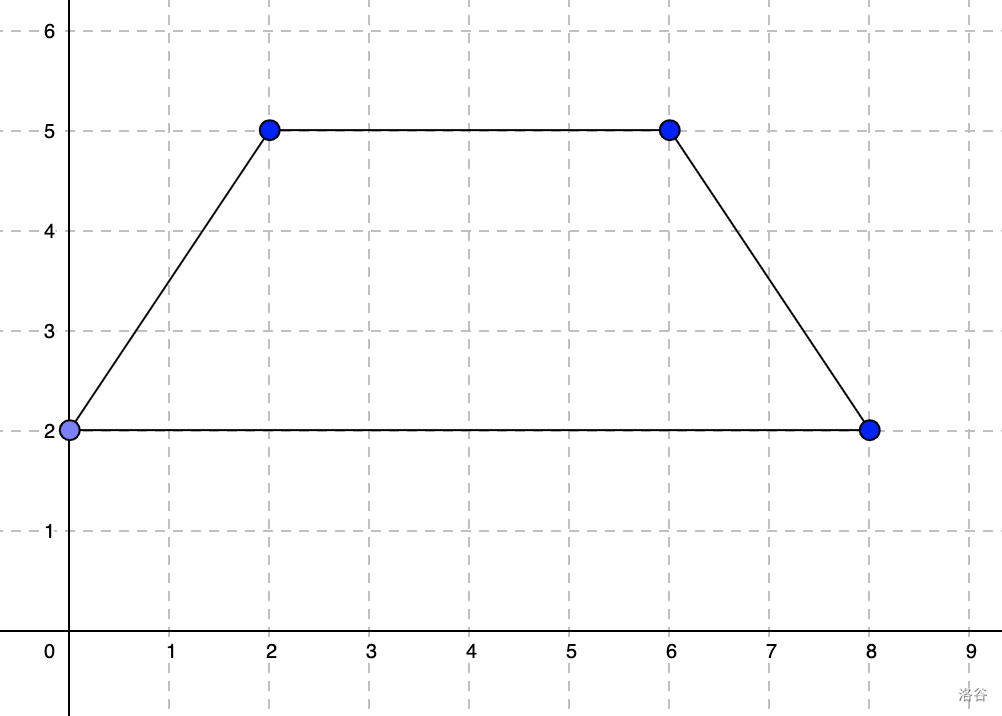
In Sample Case #$1$, we can output the above quadrilateral with coordinates $(2, 5)$, $(6, 5)$, $(0, 2)$ and $(8, 2)$. The area of this quadrilateral is equal to $18$.
In Sample Case #$2$, there is no way to construct a polygon with $5$ vertices and area equal to $1$.
:::align{center}
:::
### Limits
$1 \le T \le 100$.
$1 \le A \le 10^9$.
**Test Set $1$**
$3 \le N \le 5$.
**Test Set $2$**
$3 \le N \le 1000$.