P17214 [ICPC 2017 Nanning R] Banned Patterns
Description
:::align{center}
:::
The new censorship law has been passed and a mass of characters and strings are explicitly prohibited appearing in the public publication.
Specifically, $N$ patterns were blacklisted. To simplify the problem, we only consider the uppercase letters and each pattern is a string that consists of only uppercase letters.
The authority makes a total ban on those strings which have at least one substring matching a banned pattern.
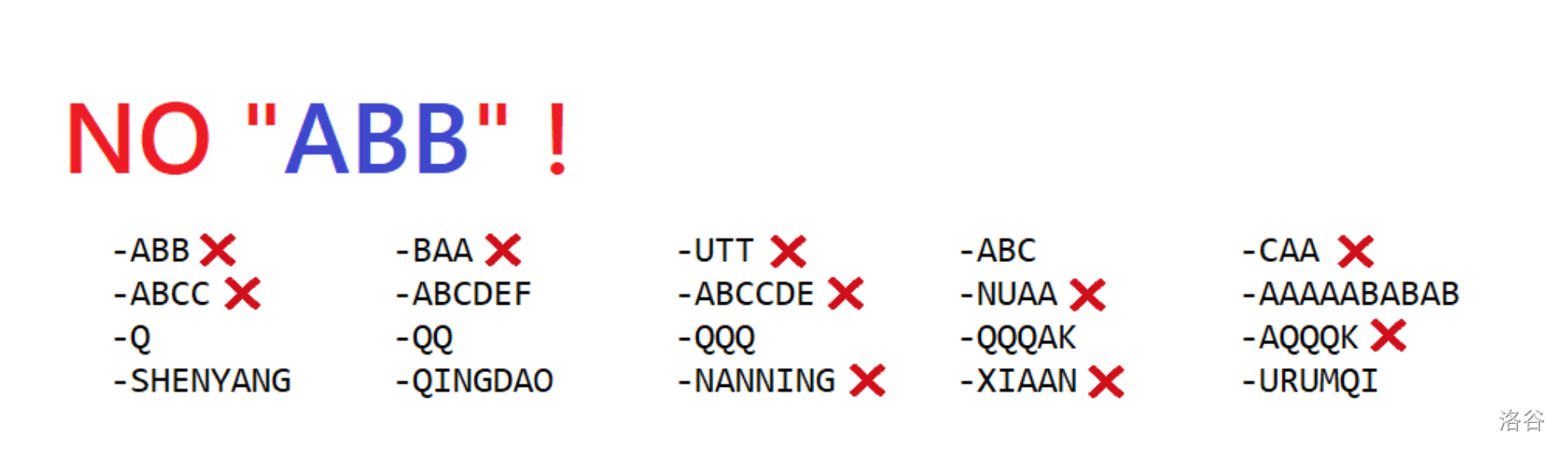
If a substring can be transmuted to a pattern by choosing a permutation of all $26$ uppercase letters, the matching satisfies the correctness. Here we list some examples.
Each two of $ABB$, $ACC$, $BAA$, $UTT$, $XZZ$ and $ZAA$ match each other.
$ABCDECBA$ matches $TYQAXQYT$ but does not match $QWEWSEWQ$.
You aim to design an efficient algorithm to judge the validity of upcoming publications.
Input Format
The first line contains a number $T (1 \le T \le 20)$ indicating the number of test cases.
For each test case, the first line is the number of banned patterns $N (1 \le N \le 5000)$.
Each of the following $N$ lines contains a pattern in capital letters.
The $(N + 2)$-th line contains an integer $M (1 \le M \le 250000)$ which is the number of strings asked to be judged based on above patterns.
Each of the following $M$ lines consists a string in capital letters as well.
The total length of patterns in a test case should not be larger than $100000$, and the total length of strings asked to be judged should not be larger than $1000000$.
Output Format
For each test case, output a line with the index and $M$ letters. Then for each given string, output “Y” if it is prohibited, or “N” if it is allowed.