P17242 [IOI 2026] Tiling Game
Description
Barchin and Charos are playing a game on a grid of $2N\times 2M$ unit square cells. The rows are
numbered $0$ to $2N −1$ from top to bottom, and the columns are numbered $0$ to $2M −1$ from left
to right. For $0 \leq i < 2N$ and $0 \leq j
Input Format
```
N M
TL[0] TR[0] BL[0] BR[0]
TL[1] TR[1] BL[1] BR[1]
...
TL[NM-1] TR[NM-1] BL[NM-1] BR[NM-1]
```
Output Format
```
R[0] C[0]
R[1] C[1]
...
R[NM-1] C[NM-1]
```
Here, $R[k]$ and $C[k]$ are the pair of integers returned by the k-th call to receive_block.
Explanation/Hint
### Example
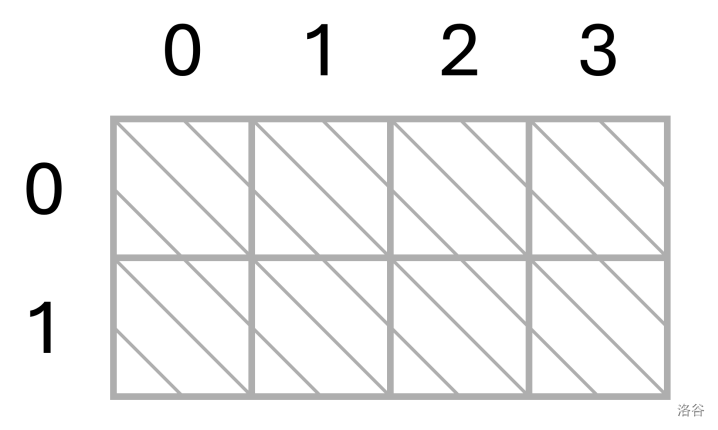
Consider a game with $N = 1$ and $M =2$, so the grid has $2$ rows and $4$ columns. The grader first calls:
```
init(1, 2)
```
Initially, all cells are empty. The grid looks like this:
:::align{center}
:::
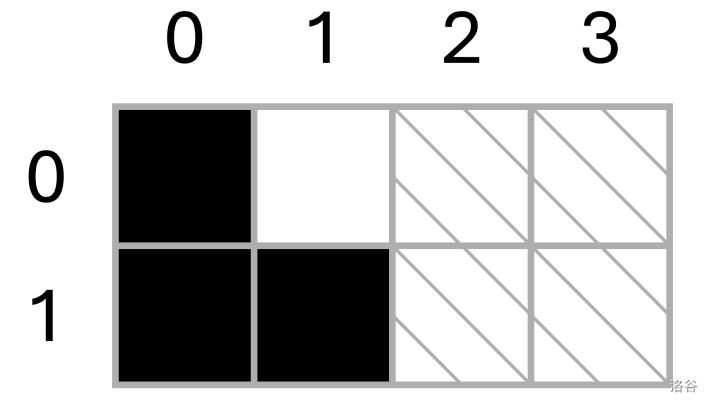
There are $N\cdot M=2$ blocks to place. Suppose Barchin gives a block with three black tiles and one white tile at the top-right corner. The grader calls:
```
receive_block(1, 0, 1, 1)
```
Charos decides to place this block at the left side of the grid by returning $(0,0)$.
The grid now looks like this:
:::align{center}
:::
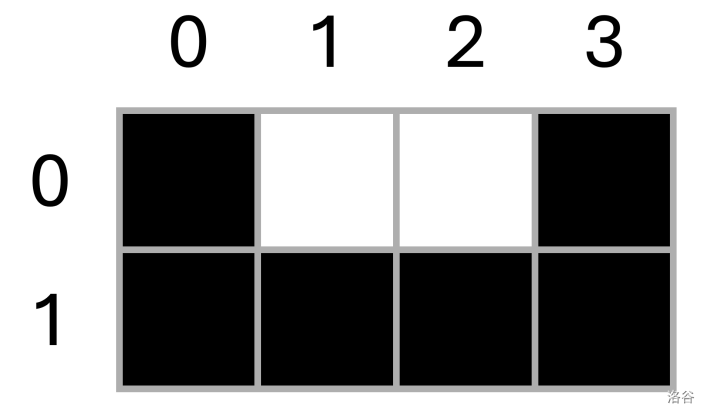
Barchin then gives another block with three black tiles and one white tile at the top-left corner:
```
receive_block(0, 1, 1, 1)
```
The only remaining cell with even row and even column that can serve as the top-left corner of a $2\times2$ block is $(0,2)$, so Charos returns $(0,2)$. The grid ends up like this:
:::align{center}
:::
No $2\times2$ square is completely covered by black tiles, so Charos has successfully placed all blocks without Barchin ever winning. Charos wins the game.
### Constraints
For each block, let $S$ be the number of black tiles among its four tiles. That is $S =TL+TR+BL+BR$.
- $1 \leq N,M \leq100$
- $0 \leq S \leq3$ for every block.
### Subtasks
::cute-table{tuack}
| Subtask | Score | Additional Constraints |
|:--:|:--:|:--:|
| $1$ | $6$ | $S=1$ for every block, and $N=2$. |
| $2$ | $16$ | $S=3$ for every block. $N=M$,$N$ is even, and each of the four possible block colorings appears exactly $\frac{N^2}{4}$ times. |
| $3$ | $10$ | $S=1$ for every block. |
| $4$ | $29$ | $S\le 2$ for every block. |
| $5$ | $39$ | No additional constraints. |