P17363 [ECNA 2024] Pascal Meets Boole
Description
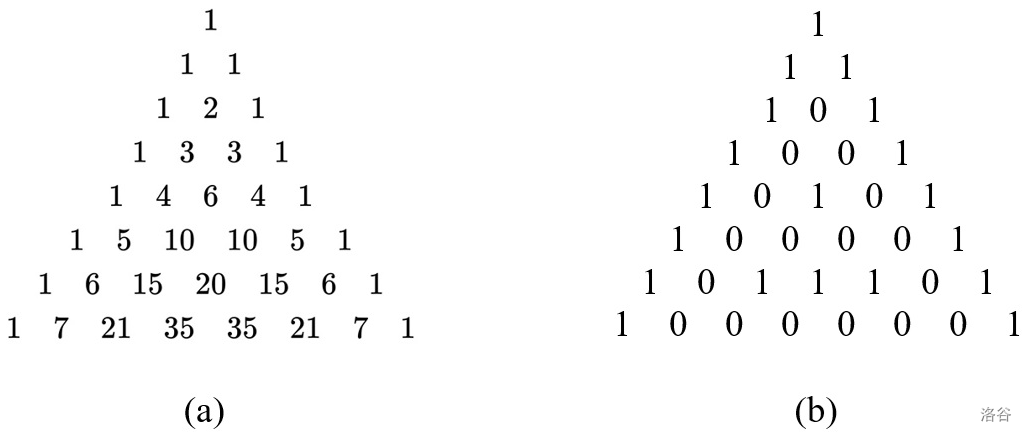
Many people are familiar with Pascal's Triangle, a triangular arrangement of integers named after the French mathematician and philosopher Blaise Pascal (1623--1662). If we number the rows of Pascal's Triangle $1, 2, 3, \ldots,$ starting from the top, then row $r$ contains $r$ elements, which we will number $1, 2, \ldots, r$ from left to right. The $1^\textrm{st}$ and $r^\textrm{th}$ elements in $\textrm{row}~r$ are set equal $\textrm{to}~1$, and for $r \geq 3$ and $1 < i < r$, $\textrm{element}~i$ in $\textrm{row}~r$ is the sum of elements $i-1$ and $i$ in row $r-1.$ More informally, each "non-edge" element is the sum of the two elements immediately above it. Figure 1(a) depicts the first $8~\textrm{rows}$ of Pascal's Triangle.
But what if we consider a rule other than standard addition for combining values? Since the edge elements are $\textrm{bits}~(1\textrm{'s}),$ a natural option is to use any two-input Boolean function, named after the English mathematician and philosopher George Boole (1815--1864). For example, the Boolean function given by the following truth table generates the triangle depicted in Figure 1(b) (where we also show the first $8~\textrm{rows}).$ In this truth table, $x$ and $y$ correspond to elements $i-1$ and $i,$ respectively, in $\textrm{row}~r-1$, and $f(x,y)$ is the resulting $\textrm{element}~i$ in $\textrm{row}~r$.
| $x$ | $y$ | $f(x,y)$ |
|-----|-----|----------|
| $0$ | $0$ | $1$ |
| $0$ | $1$ | $0$ |
| $1$ | $0$ | $0$ |
| $1$ | $1$ | $0$ |
In general, if we label the bits in the rightmost column of any such truth table $b_{00}, b_{01}, b_{10}, b_{11}$ from top to bottom, then we can compactly represent a two-input Boolean function by the $4\textrm{-bit}$ string $b_{00} b_{01} b_{10} b_{11}.$ So the example function above is represented by $1000$.
Your challenge is to answer two kinds of questions about "Pascal-Boole" triangles:
1. For a given Boolean function, $f,$ what is the bit in row $r$, position $i$?
2. For a given Boolean function, $f,$ how many $1\textrm{'s}$ are there in the first $r$ rows?
:::align{center}
:::
Input Format
The first line of input contains an integer, $n$ $(1 \leq n \leq 250),$ the number of test cases. This is followed by $n$ lines, each of which has one of two forms:
1. $f$ `B` $r$ $i$
2. $f$ `N` $r$
In both cases, $f$ is a $4\textrm{-bit}$ binary string representing a two-input Boolean function, and $r$ is an integer $(1 \leq r \leq 10^6).$ In the first case, $i$ is an integer $(1 \leq i \leq r).$
Output Format
For a test case of the form $f~\texttt{B}~r~i,$ output a line containing the bit in $\textrm{row}~r,$ $\textrm{position}~i$ of the Pascal-Boole triangle generated $\textrm{using}~f.$ For a test case of the form $f~\texttt{N}~r,$ output a line containing the number of $1\textrm{'s}$ in the first $r~\textrm{rows}$ of the Pascal-Boole triangle generated $\textrm{using}~f.$