P4390 [BalkanOI 2007] Mokia
Description
The mobile phone company Mokia in Morvado has designed a new user localization system. Like other localization systems, it can quickly answer any question of the form “Where is user C?”, accurate to the millimeter. But its truly high-tech feature is that it can answer questions like “How many users are there in a given area?”.
In this localization system, the world is considered a $w\times w$ square region, composed of $1\times 1$ cells. Each cell has a coordinate $(x, y)$, $1\leq x,y\leq w$. Coordinates are 1-indexed. For a $4\times 4$ square, we have $1\leq x\leq 4$, $1\leq y\leq 4$ (see the figure).
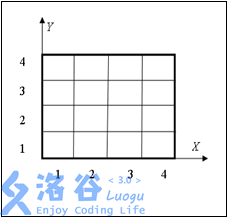
Please help Mokia write a program to compute how many users are in a rectangular region.
Input Format
There are three types of commands with the following meanings:
| Command | Parameters | Meaning |
|:-:|:-:|:-:|
| $0$ | $w$ | Initialize an all-zero matrix. This command appears exactly once at the beginning. |
| $1$ | $x\ y\ a$ | Add $a$ users to cell $(x, y)$. $a$ is a positive integer. |
| $2$ | $x_1\ y_1\ x_2\ y_2$ | Query the number of users in the rectangle defined by $x_1\leq x\leq x_2$, $y_1\leq y\leq y_2$. |
| $3$ | none | End the program. This command appears exactly once at the end. |
The input consists of multiple lines. Each line contains several integers representing one command.
Output Format
For every command $2$, output one integer on a separate line: the number of users currently in the queried rectangle.
Explanation/Hint
Constraints
For $100\%$ of the testdata, it is guaranteed that:
- $1\leq w\leq 2\times 10 ^ 6$.
- $1\leq x_1\leq x_2\leq w$, $1\leq y_1\leq y_2\leq w$, $1\leq x,y\leq w$, $0