P4710 “Physics” Horizontal Projectile Motion
Background
# Description
> After returning to class and seeing his 28/110 in physics, little F felt utterly defeated. He decides to start learning mechanics from the very basics.
As shown in the figure, a small ball that can be treated as a point mass is thrown from point $A(x_0, y_0)$ along the negative direction of the $x$-axis with some speed, ignoring all resistance except gravity, and finally hits point $B(0, 0)$ exactly with speed $v$.
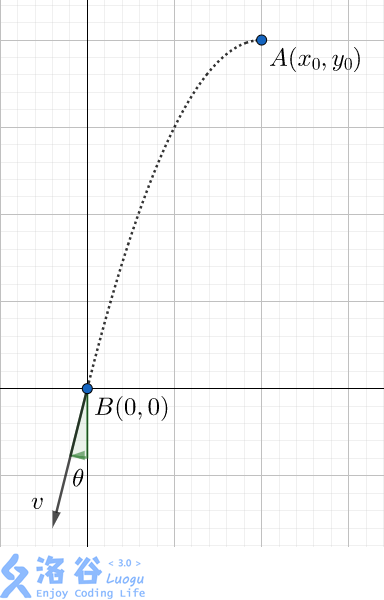
Given the magnitude and direction of $v$, your task is to find $(x_0, y_0)$.
The unit of the given speed is $m \cdot s ^ {-1}$, and the gravitational acceleration is $g = 10 \ (m \cdot s ^ {-2})$. Please output the answer in meters.
If you have not learned the related content, it is okay; you can understand what is required from the samples and the hints.
Description
> 小 F 回到班上,面对自己 28 / 110 的物理,感觉非常凉凉。他准备从最基础的力学学起。
如图,一个可以视为质点的小球在点 $A(x_0, y_0)$ 沿 $x$ 轴负方向以某速度抛出,无视除重力外的所有阻力,最后恰好以速度 $v$ 砸到 $B(0, 0)$ 点。

给定 $v$ 的大小与方向,你的任务是求出 $(x_0,y_0)$。
给定的速度单位为 $m \cdot s ^ {-1}$,重力加速度 $g = 10 \ (m \cdot s ^ {-2})$,请输出以 $m$ 为单位的答案。
如果你没有学过相关内容也没有关系,你可以从样例和提示里理解该题所求内容。
Input Format
输入一行,为两个最多 $6$ 位的小数 $v, \theta(1 \leq v \leq 100, 15 ^ \circ \leq \theta \leq 75 ^ \circ )$,即速度与图中所标角在弧度制下的大小。
Output Format
Output one line with two real numbers $x_0, y_0$ (each with at most $15$ decimal places), which are your answers.
Your answer is considered correct if the absolute or relative error is less than $10 ^ {-3}$.
Explanation/Hint
### Sample Explanation
As shown.
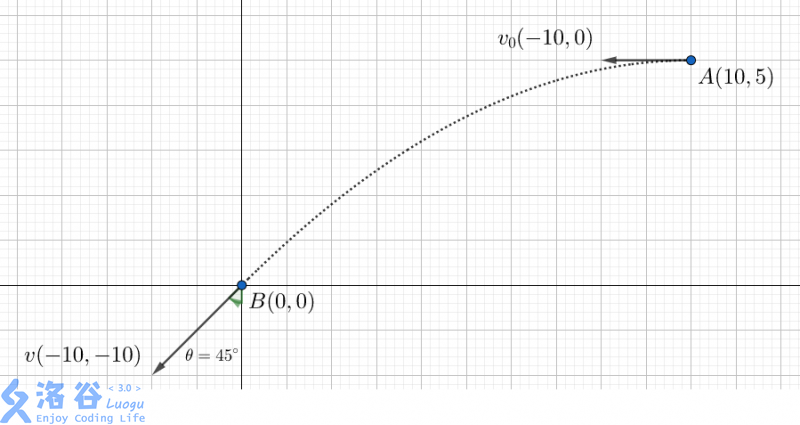
$14.142136 \approx 10 \sqrt 2, 0.785398 \approx \frac \pi 4 = 45 ^ \circ.$
If the ball is thrown from $(10, 5)$ with velocity $(-10, 0)$, then at $t = 1 s$ it hits $(0, 0)$ with velocity $(-10, -10)$.
### Hint
If you have not studied the related content, the following may help:
> zcy teaches you physics
First, since all units are standard, all results can be computed directly with numbers; treating the object as a point mass means it has no volume.
We can decompose the velocity of the ball as shown:
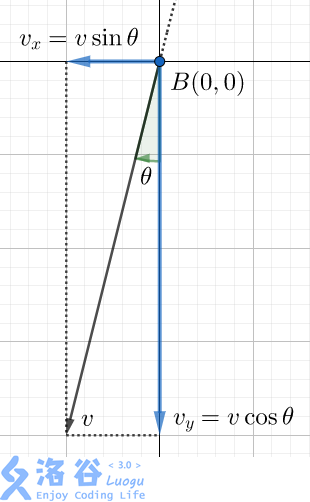
The horizontal component of the velocity $v_x$ is the initial throw speed and remains $v \sin \theta$ during the motion.
The vertical component of the velocity $v_y$ is accelerated by gravity, changing from $0$ to $v \cos \theta$.
Starting timing from the moment of release, when the time is $t$, let the magnitudes of the horizontal and vertical velocities at this moment be $v_{xt}, v_{yt}$, and the magnitudes of the horizontal and vertical displacements be $x_{xt}, x_{yt}$, respectively. Then:
$v_{xt} = v \sin \theta$
$v_{yt} = gt$
$x_{xt} = v_{xt}t$
$x_{yt} = \frac 1 2 g t ^ 2 = \frac 1 2{v_{yt}t}$
When $t$ is exactly the landing time, $x_{xt}, x_{yt}$ are the answers.
---
About radians:
$\pi = 180 ^{\circ}$
That is: $\frac \pi 2 = 90 ^{\circ}, \frac \pi 3 = 60 ^{\circ}, \ \cdots $
---
About trigonometric functions:
If you use C/C++, you can use `sin()` and `cos()` from `math.h` / `cmath`.
If you use Pascal, you can use `sin()` and `cos()` from the `math` library (add `uses math;` before `begin`).
If you use Python, you can use `math.sin()` and `math.cos()` from the `math` library.
If you use other languages, please refer to the corresponding documentation.
Translated by ChatGPT 5