P5280 [ZJOI2019] Segment Tree
Description
Jiutiao Kelian is a girl who likes data structures. Among common data structures, her favorite is the segment tree.
The core of a segment tree is lazy propagation. Below is pseudocode for a segment tree with lazy tags, where the array $tag$ is the lazy tag:
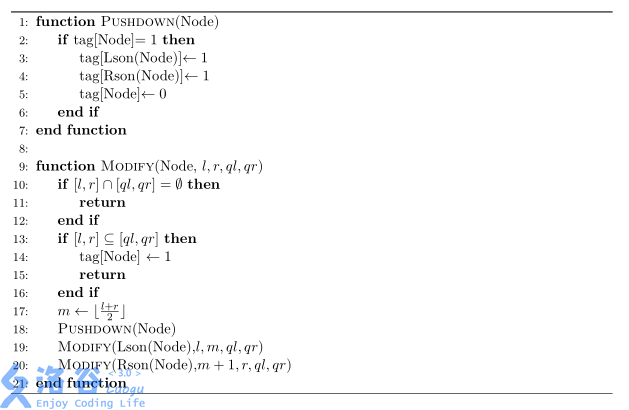
Here, the function $\operatorname{Lson}(Node)$ denotes the left child of $Node$, and $\operatorname{Rson}(Node)$ denotes the right child of $Node$.
Now Kelian has a segment tree over $[1,n]$, with index $1$. All nodes in this segment tree have $tag = 0$. Then Kelian performs $m$ operations. There are two types of operations:
- $1\ l\ r$: Suppose Kelian currently has $t$ segment trees. She will copy each segment tree into two copies (the $tag$ array is copied as well). The segment tree originally indexed $i$ becomes two copied trees indexed $2i-1$ and $2i$. After copying, she has $2t$ segment trees in total. Then, she performs $\operatorname{Modify}(root,1,n,l,r)$ once on every segment tree whose index is odd.
- $2$: Kelian defines the weight of a segment tree as the number of nodes in it whose $tag$ equals $1$. She wants to know the sum of weights of all segment trees she currently has.
Input Format
The first line contains two integers $n,m$, denoting the initial interval length and the number of operations.
Each of the next $m$ lines describes one operation. The input guarantees $1 \le l \le r \le n$.
Output Format
For each query, output one integer per line representing the answer. The answer can be very large, so output it modulo $998244353$.
Explanation/Hint
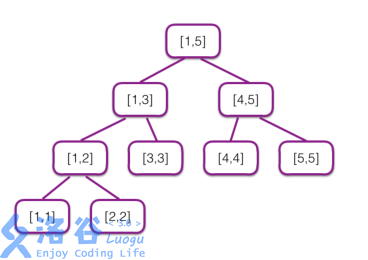
The segment tree over $[1,5]$ is shown below:
At the first query, Kelian has one segment tree, and there are no marks on any node, so the answer is $0$.
At the second query, Kelian has two segment trees. By their indices, their marked nodes are:
1. Node $[1,3]$ is marked, so the weight is $1$.
2. No node is marked, so the weight is $0$.
So the answer is $1$.
At the third query, Kelian has four segment trees. By their indices, their marked nodes are:
1. Nodes $[1,2],[3,3],[4,5]$ are marked, so the weight is $3$.
2. Node $[1,3]$ is marked, so the weight is $1$.
3. Nodes $[3,3],[4,5]$ are marked, so the weight is $2$.
4. No node is marked, so the weight is $0$.
So the answer is $6$.
|Test Point|$n$|$m$|Other Constraints|
|:-:|:-:|:-:|:-:|
|$1$|$\le 1000$|$\le 10$|None|
|$2$|^|^|^|
|$3$|^|$\le 1000$|^|
|$4$|^|^|^|
|$5$|$\le 10^5$|$\le 10^5$|There is only one query|
|$6$|^|^|^|
|$7$|^|^|^|
|$8$|^|^|None|
|$9$|^|^|^|
|$10$|^|^|^|
For $100\%$ of the data, $1 \le l \le r \le n$.
Translated by ChatGPT 5