P5392 [Cnoi2019] Appointment of the Cedar Tree
Background
Because Cirno suddenly became lazy, the background story is skipped.
Description
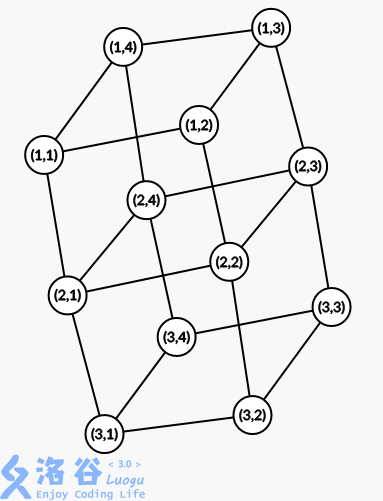
Cirno defines a type of graph: the cylindrical network $G(L, x)$.
$G(L, x)$ denotes a graph with $L \times x$ nodes.
Each node is represented by an ordered pair of integers $(a, b)$, where $(1 \le a \le L, 1 \le b \le x)$.
For $\forall i \in (1, L],\ j \in (0, x]$, there is an edge between node $(i, j)$ and node $(i - 1, j)$.
For $\forall i \in [1, L],\ j \in (0, x)$, there is an edge between node $(i, j)$ and node $(i, j + 1)$.
For $\forall i \in [1, L]$, there is an edge between node $(i, x)$ and node $(i, 1)$.
Now Cirno wants to know the number of **independent sets** of $G(L, x)$.
Since you cannot do big integer arithmetic, you need to output the answer modulo $998244353$.
Input Format
One line with two integers $L$ and $x$.
Output Format
One line with one integer, the number of independent sets of $G(L, x)$ modulo $998244353$.
Explanation/Hint
For the first $10\%$ of the testdata, $L, x \le 8$.
For the first $30\%$ of the testdata, $x \le 8$.
For the first $50\%$ of the testdata, $x \le 11$.
For $100\%$ of the testdata, $0 < L \le 10^{18},\ 0 < x \le 17$.
This problem uses bundled tests.
The figure below is an example of $G(3, 4)$.
Translated by ChatGPT 5