P5677 [GZOI2017] Pairing Statistics
Background
GZOI2017 D1T3
Description
Given $n$ numbers $a_1,\cdots,a_n$.
For a pair $(x,y)$, if for all $i=1,2,\cdots,n$, it satisfies $|a_x-a_y|\le|a_x-a_i|(i\not=x)$, then $(x,y)$ is called a good pair ($|x|$ denotes the absolute value of $x$).
You are given several queries. For each query, ask how many good pairs are contained in the interval $[l,r]$.
That is, choose $x,y$ ($l\le x,y\le r$ and $x\not=y$), and ask how many pairs $(x,y)$ are good pairs.
Input Format
The first line contains two positive integers $n,m$.
The second line contains $n$ numbers $a_1,\cdots,a_n$.
In the next $m$ lines, each line gives two numbers $l,r$.
Output Format
Let $Ans_i$ be the answer to the $i$-th query. Output $\sum_{i=1}^m\limits Ans_i\times i$.
Explanation/Hint
**Sample Explanation**
In the first query, the good pairs are: $(1,2)(2,1)$.
In the second query, the good pairs are: $(1,2)(2,1),(1,3)(3,1)$.
The answer $=2\times 1+4\times 2=10$.
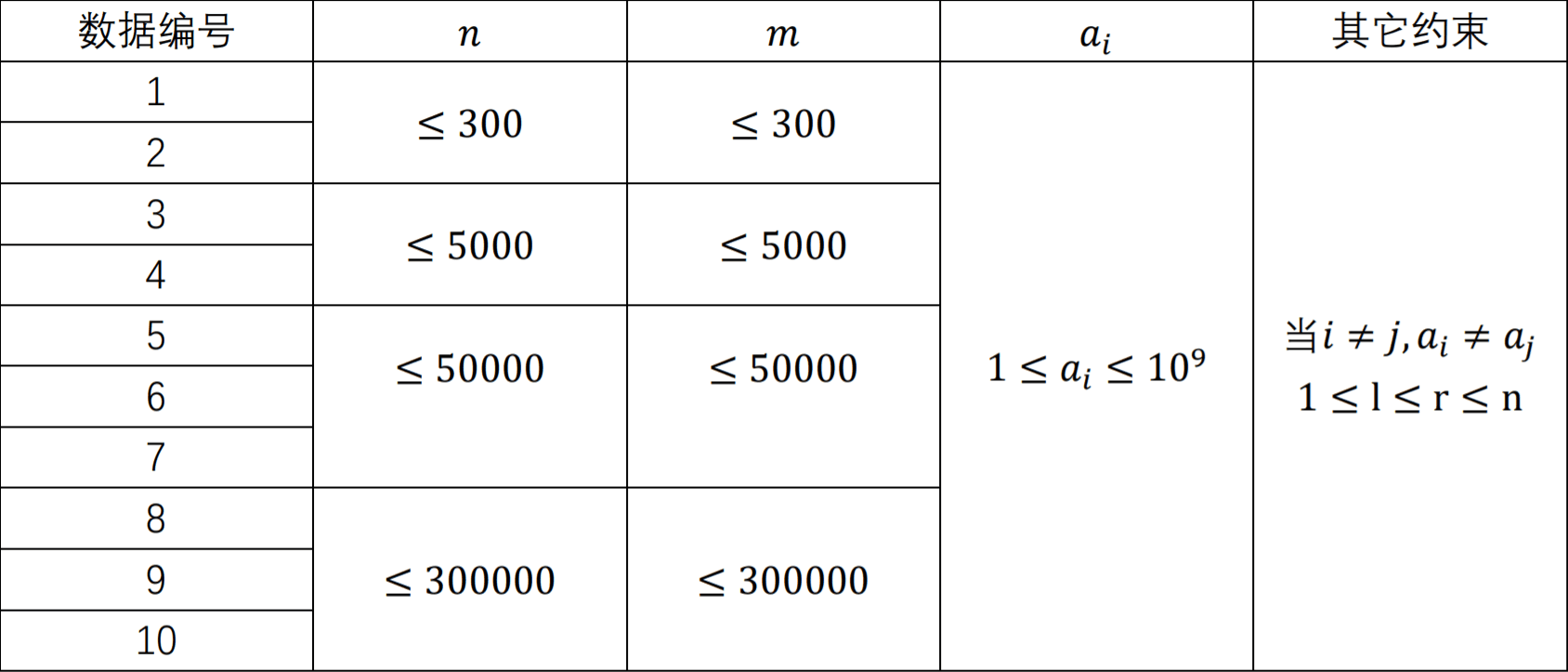
**Constraints**
Translated by ChatGPT 5