P5867 [SEERC 2018] Fishermen
Description
The sea can be considered as the first quadrant of the Cartesian coordinate system. There are $n$ fish in the sea, and each fish has a two-dimensional coordinate. There may be multiple fish at the same point.
There are $m$ fishermen on the shore. Each fisherman has an $x$ coordinate, and their $y$ coordinate is always $0$.
Each fisherman has a fishing rod of length $l$, so he can catch fish whose distance to him is at most $l$. The distance between a fisherman with $x$ coordinate $x$ and a fish at coordinate $(a,b)$ is $|a-x|+b$.
For each fisherman, compute how many fish he can catch.
Input Format
The first line contains three integers $n, m$ and $l \ (1 \leq n,m \leq 2 \cdot 10^5, 1 \leq l \leq 10^9)$, representing the number of fish, the number of fishermen, and the length of the fishing rod.
The next $n$ lines each contain two integers $x_i$ and $y_i \ (1 \leq x_i, y_i \leq 10^9)$, representing the coordinates of each fish.
The next line contains $m$ integers $a_i \ (1 \leq a_i \leq 10^9)$, representing the $x$ coordinate of each fisherman.
Output Format
For each fisherman, output one line with the answer.
Explanation/Hint
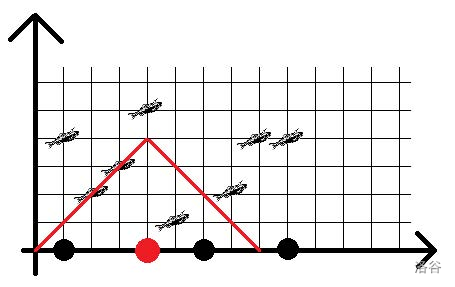
The picture shows the region where the third fisherman in the sample above can catch fish.
Translated by ChatGPT 5