P6234 [eJOI 2019] T-shaped Covering
Description
If you have played Tetris, you should have seen the following shape:
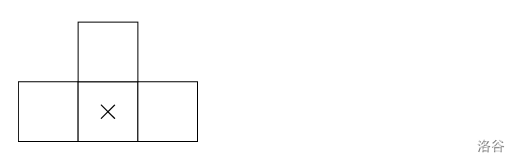
We call it a ***T-shaped tetromino***. Its **center** is marked by $\times$.
Manca drew a rectangular grid with $m$ rows and $n$ columns. Rows are numbered from $0$ to $m-1$, and columns are numbered from $0$ to $n-1$. She marked some cells in the grid as ***special cells***. Then, she wants her friend Nika to help her place T-shaped tetrominoes according to the following rules:
- The number of special cells is the same as the number of T-shaped tetrominoes, and the center of each T-shaped tetromino must be on a special cell in the grid.
- T-shaped tetrominoes must not overlap.
- All parts of all tetrominoes must lie inside the grid.
Note that a T-shaped tetromino has four orientations: $\bot \top \vdash \dashv$.
If no arrangement exists, output `No`. Otherwise, find an arrangement that maximizes the sum of the numbers in the covered cells, and output this maximum value.
Input Format
The first line contains two integers $m,n$, representing the number of rows and the number of columns.
The next $m$ lines each contain $n$ integers. The $j$-th number in the $i$-th line (indexed from $0$) represents the value $a_{i,j}$ in the cell at row $i$ and column $j$.
The next line contains one integer $k$, representing the number of special cells.
The next $k$ lines each contain two integers $r_i,c_i$, representing the position of the $i$-th special cell.
Output Format
If an arrangement exists, output the maximum possible sum of the numbers in the covered cells. Otherwise, output `No`.
Explanation/Hint
#### Explanation of Sample Input/Output 1
One optimal arrangement is as follows:
- The tetromino centered at $(1,1)$ is oriented as $\dashv$.
- The tetromino centered at $(2,2)$ is oriented as $\vdash$.
- The tetromino centered at $(3,4)$ is oriented as $\bot$.
--------------------------
#### Constraints and Notes
**This problem uses bundled testdata and has 7 subtasks.**
- Subtask 1 (5 points): $k\le 10^3$, and it is guaranteed that for all $i\ne j$, $\max(|r_i-r_j|,|c_i-c_j|)>2$.
- Subtask 2 (10 points): $k\le 10^3$, and it is guaranteed that for all $i\ne j$, if $\max(|r_i-r_j|,|c_i-c_j|)\le 2$, then $(r_i,c_i)$ and $(r_j,c_j)$ share an edge.
- Subtask 3 (10 points): $k\le 10^3$, and it is guaranteed that for all $i\ne j$, $\max(|r_i-r_j|,|c_i-c_j|)\ne 2$.
- Subtask 4 (10 points): All special cells are in the same row.
- Subtask 5 (15 points): $k\le 10$.
- Subtask 6 (20 points): $k\le 10^3$.
- Subtask 7 (30 points): No additional constraints.
For all testdata: $1\le k\le nm\le 10^6$, $a_{ij}\in[0,10^3]$, $r_i\in[0,m)$, $c_i\in[0,n)$.
---------------------------
#### Notes
The original problem is from: [eJOI2019](https://www.ejoi2019.si) Problem C. [T - Covering](https://www.ejoi2019.si/static/media/uploads/tasks/covering-isc(1).pdf).
The translation is from: [LibreOJ](https://loj.ac/problem/3197)。
Translated by ChatGPT 5