P7807 Magic Growth
Background
Source: [Eight Immortals Toasting](/paste/78f1vlm0), which you can click.
- Lü Dongbin — Drunkenly lifts the pot with immense strength.
- Tieguai Li — Spins the elbow and knee, drunk yet real.
- Han Zhongli — Stumbles, hugs the jar, and rams the heart.
- **Lan Caihe — Lifts a toast with one hand and breaks the waist block**.
- Zhang Guolao — Drunkenly throws the cup and kicks in a chain.
- Cao Guojiu — The immortal toasts and locks the throat.
- Han Xiangzi — Grabs the wrist, strikes the chest, and drunkenly plays the flute.
- He Xiangu — Bends the waist to offer wine, drunkenly swaying her steps.
Description
You are given a tree $T$ with $n$ nodes, where the number of nodes connected to any node is at most $2$.
Now perform operations on nodes $u = 1 \sim n$ in order:
- Randomly choose an integer $x(\ge k)$.
- Create $x$ new nodes, and connect each new node to $u$ with an edge.
Obviously, after all operations, the result is still a tree $T'$, whose number of nodes is $m = n + \sum x$.
Given the resulting tree $T'$ and its number of nodes $m$, reconstruct the original tree $T$. If there are multiple solutions, output **any one** that makes $\color{black}n$ **as large as possible**.
Note that during reconstruction and output, we only care about the shape of the tree, not the relative numbering of nodes.
Input Format
The first line contains two positive integers $m, k$, representing the number of nodes in tree $T'$ and the lower bound of the random number $x$.
Lines $2 \sim m$ each contain two positive integers $u, v$, representing an edge in $T'$.
Output Format
The first line outputs one positive integer $n$, the number of nodes in the constructed tree $T$.
Lines $2 \sim n$ each output two positive integers $u, v$, representing an edge in $T$.
The output $u, v$ must satisfy: $1 \le u, v \le n$.
Explanation/Hint
#### Sample Explanation
In sample $\#1$, only node $1$ can be in tree $T$: its corresponding $x$ is $4$.
In sample $\#2$, nodes $1, 2, 3$ are in tree $T$: node $1$ corresponds to $x$ being $4$, and nodes $2, 3$ correspond to $x$ being $0$.
In sample $\#3$, nodes $1, 2, 3$ are in tree $T$: their randomly chosen $x$ are all $2$.
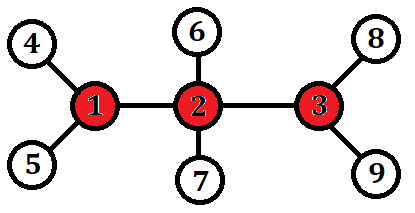
Sample $\#3$ provides an illustration. The red nodes represent the nodes in tree $T$, and all nodes in the figure are on $T'$.
#### Constraints
| Subtask | Score | $x=$ |
| :----------: | :----------: | :----------: |
| $1$ | $30$ | $0$ |
| $2$ | $30$ | $1$ |
| $3$ | $40$ | |
| $4$ | $0$ | Hack |
Note: Subtask 4 is unscored Hack testdata. Only if you pass all subtasks $1 \sim 4$ will it be considered AC.
For $100\%$ of the data: $1 \le m \le 10^5, k \in [0, m)$, and the input guarantees that a solution exists.
---
### Afterword
Aurora magic flowers are so cute $\sim$
Translated by ChatGPT 5