P8067 [BalkanOI 2012] balls
Background
You are playing a physics line-drawing game.
Description
There are $N$ balls and $N$ cups, numbered from left to right as $1\dots N$. Initially, ball $i$ is aimed at cup $i$ (if nothing affects it, ball $i$ will fall into cup $i$). Cup $i$ has a score $c_i$. When a ball falls into a cup, you gain that cup’s score (cup capacity is considered infinite). Scores can be negative.
You can draw two types of lines. Both endpoints of a line must be aimed at some cups, and the two endpoints cannot be the same cup.
1. From upper-left to lower-right. Let the cup aimed at by the upper-left endpoint be $i$, and the cup aimed at by the lower-right endpoint be $j$. Then all balls with indices $i\dots j$ will fall into cup $j$.
1. From upper-right to lower-left. Let the cup aimed at by the lower-left endpoint be $i$, and the cup aimed at by the upper-right endpoint be $j$. Then all balls with indices $i\dots j$ will fall into cup $i$.
Now you want to know the maximum score you can get using **exactly one** line of the first type, and the maximum score you can get using **exactly one** line of the second type, respectively.
Input Format
The first line contains an integer $N$.
The next line contains $N$ integers, denoting $c_1\dots c_N$.
Output Format
Output one integer on the first line: the maximum score when using only the first type of line.
Output one integer on the second line: the maximum score when using only the second type of line.
Explanation/Hint
#### Constraints
Subtask #0 is the sample.
$3\le N\le3\times10^5$, $|c_i|\le10^9$.
#### Sample Explanation
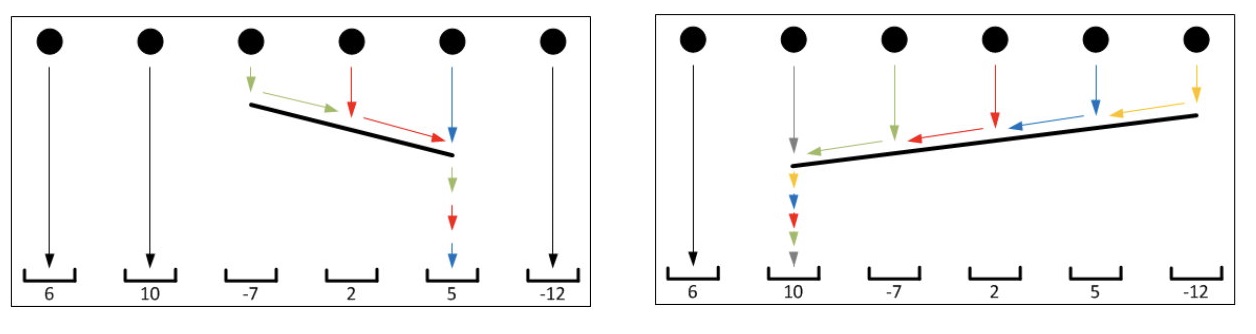
The first picture shows the first type of line. Score: $6+10+5+5+5+(-12)=19$, and it can be proven to be the maximum.
The second picture shows the second type of line. Score: $6+10+10+10+10+10=56$, and it can be proven to be the maximum.
Translated by ChatGPT 5