P8114 [Cnoi2021] Hexagon Warrior
Background
With Cirno’s careful care, the hexagon has grown into a cute parallelogram-like hexagon.
Now, Cirno really wants to know how strong its fighting power is.
Description
In this cute parallelogram-like hexagon, the angle between every pair of adjacent sides is $\frac{2\pi}{3}$. The lengths of the three pairs of opposite sides are $a$, $b$, and $c$ units, respectively, as shown in the figure.
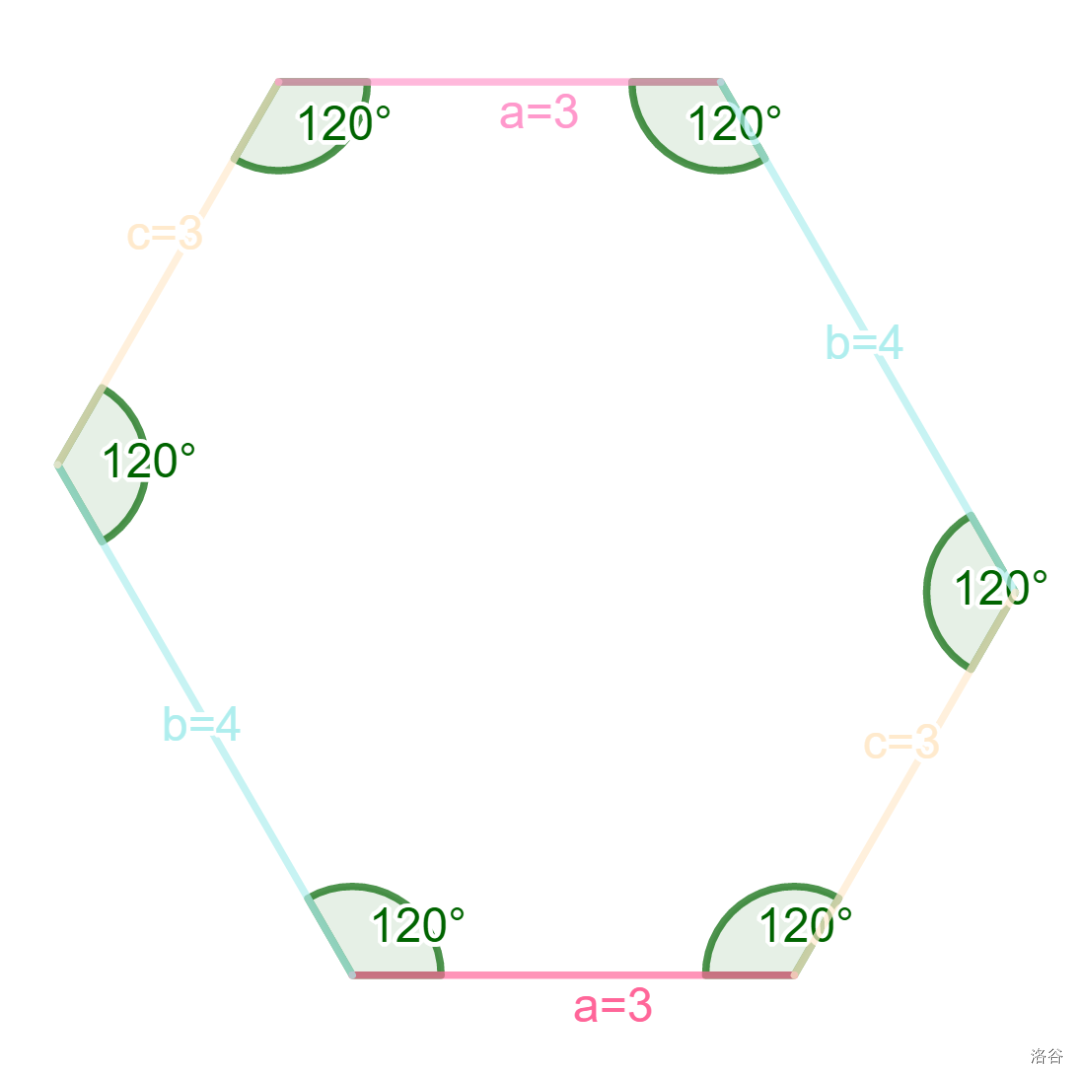
During the fighting power evaluation, the evaluator builds, for each line containing a side of the hexagon, a family of parallel lines spaced $\frac{\sqrt{3}}{2}$ units apart. In this way, the hexagon warrior is divided into several equilateral triangles, as shown in the figure.

The evaluator then connects all equilateral triangles that share a common edge. Since there is no odd cycle, it is easy to see that this is a bipartite graph. Then the evaluator tries to construct a perfect matching of this bipartite graph, as shown in the figure.
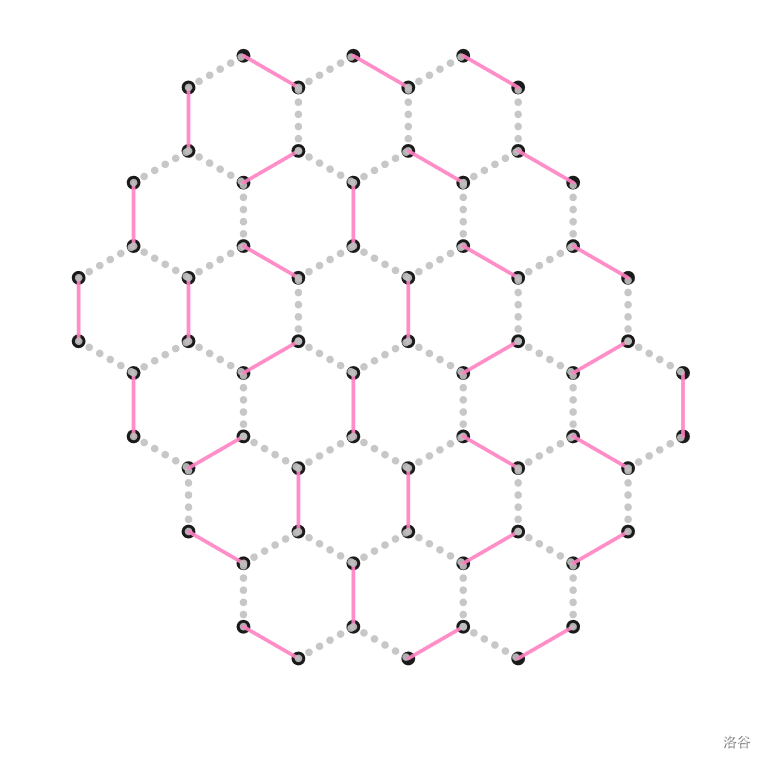
The fighting power of this hexagon warrior is the number of possible **perfect matchings of the above bipartite graph**. As a trainee evaluator, you need to help Cirno compute the fighting power of this hexagon.
Since the answer may be too large, you only need to output it modulo $998244353$.
Input Format
One line with three integers separated by spaces, representing $a$, $b$, and $c$.
Output Format
One line with one integer, representing the fighting power of the hexagon warrior modulo $998244353$.
Explanation/Hint
**Constraints and Notes**
For $100\%$ of the data, it is guaranteed that $1 \le a, b, c \le 10^6$.
**Subtasks**
Subtask 1 ($10$ points): $a, b, c \le 3$.
Subtask 2 ($10$ points): $a, b, c \le 8$.
Subtask 3 ($70$ points): $a, b, c \le 100$.
Subtask 4 ($10$ points): No special constraints.
**Hint**
- **Krattenthaler’s formula**
$\displaystyle\det\left(\prod\limits_{k=2}^j(x_i+a_k)\prod\limits_{k=j+1}^n(x_i+b_k)\right)_{i,j=1}^{n}=\prod\limits_{1\le i