P8137 [ICPC 2020 WF] 'S No Problem
Background
ICPC2020 WF J
Description
The Yllihc Engineering and Technological Institute (YETI),
located in upper northern Snowblovia, has two problems: snow
and money. Specifically, they have too much of the former and not
enough of the latter. Every winter (and fall and spring for that matter)
the campus is covered with blankets of snow. The maintenance staff
must clear all the sidewalks connecting the campus buildings, but they
have only two snow blowers and have been told in no uncertain
terms that they cannot expect to obtain any more in the near future.
To preserve the longevity of these two precious machines,
the staff has decided on the following snow removal procedure.
Each machine is assigned a fixed route connecting two of the
buildings on campus. Whenever snow must be removed, each snow blower
is taken from the building at one end of its route and used to clear snow,
ending up in the building at the other end of its route, where it is
stored until the next snowfall.
The reverse movement will occur during the next snow removal event---each
machine will trace its assigned route in the opposite direction.
This process cycles throughout the eleven-month snow season.
Note that a route might involve doubling back over sidewalks that
have already been cleared. Also, it is
possible that the same building might be an endpoint for both
snow blower routes.
The campus sidewalks are laid out in the form of a tree.
To run the machines as little as possible, the staff wants
to minimize the total distance
that the snow blowers must travel as they are guided along their routes.
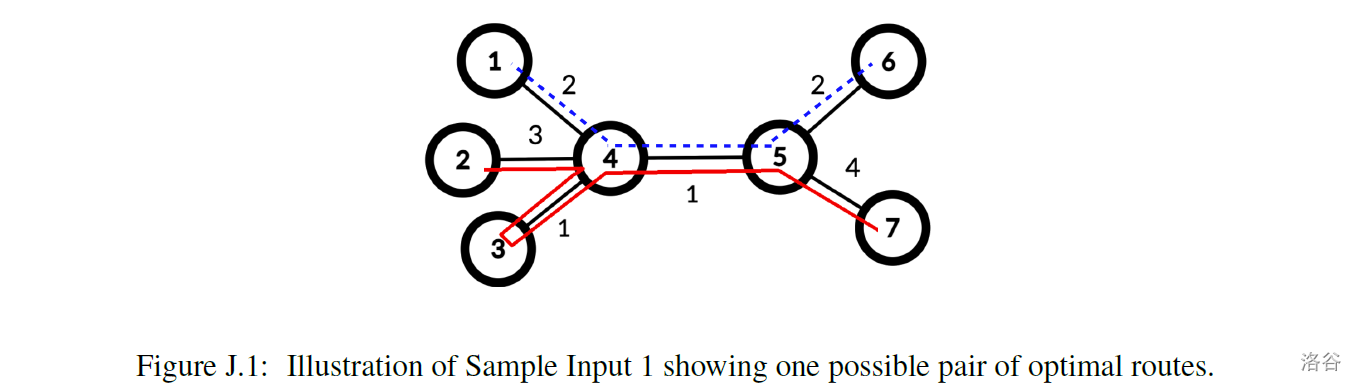
Figure J.1 shows an optimal
solution for the sidewalk layout of the first sample input.
The YETI maintenance crew would ask the Computer Science Department
at YETI to figure this out, but they were wiped out in the Great
Blizzard of '$06$, so they have come to you for help.
Input Format
The first line of input contains an integer $n$ ($4\leq n\leq 100\,000$),
the number of buildings on the YETI campus. Buildings are numbered from $1$
to $n$.
Each of the remaining $n-1$ lines contains three integers
$a$, $b$, and $d$
indicating that a two-way sidewalk exists between buildings $a$ and $b$
($1 \leq a, b \leq n$; $a\ne b$) of length $d$ ($1\leq d\leq 500$).
Output Format
Output the minimum total distance the two machines must travel in
any snow removal event.