P9036 "KDOI-04" Challenge NPC III
Background
Description
Xiao S has a great dream: to prove that $\text{P}=\text{NP}$.
One day, after learning that the maximum independent set problem on general graphs is an NPC problem, he decided to solve it.
Of course, Xiao S is too weak to solve it, so he asks you for help:
> Given an undirected graph $G$ with $n$ vertices and $m$ edges, find the number of independent sets in $G$ whose size is exactly $n-k$. Since the answer may be very large, output it modulo $998~244~353$.
Xiao S does not like multiple test cases, because he lost points in NOIp due to multiple test cases, so this problem contains multiple groups of testdata.
Input Format
**This problem contains multiple groups of testdata.**
The first line contains a positive integer $T$, the number of test cases.
For each test case, the first line contains three positive integers $n,m,k$.
The next $m$ lines each contain two positive integers $u,v$, representing an edge.
It is guaranteed that there are no self-loops in the graph, but **there may be multiple edges**.
Output Format
For each test case, output one line with one positive integer, the number of independent sets that meet the requirement, modulo $998~244~353$.
Explanation/Hint
**[Sample Explanation]**
For test cases $1$ and $2$, the graph is a complete graph. It is easy to see that the maximum independent set of a complete graph has size $1$, and each single vertex forms an independent set. Therefore, the answer for test case $1$ is $0$, and the answer for test case $2$ is $4$.
For test case $3$, the undirected graph is as follows:
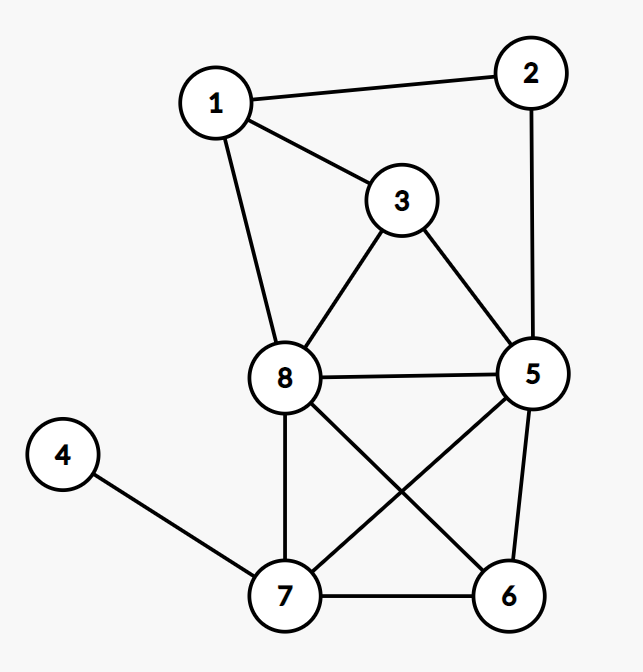
All independent sets of size $3$ are:
+ $\{2,4,8\}$;
+ $\{2,3,7\}$;
+ $\{3,4,6\}$;
+ $\{2,4,6\}$;
+ $\{1,4,6\}$;
+ $\{2,3,6\}$;
+ $\{1,4,5\}$;
+ $\{2,3,4\}$。
**[Constraints]**
**This problem uses bundled tests.**
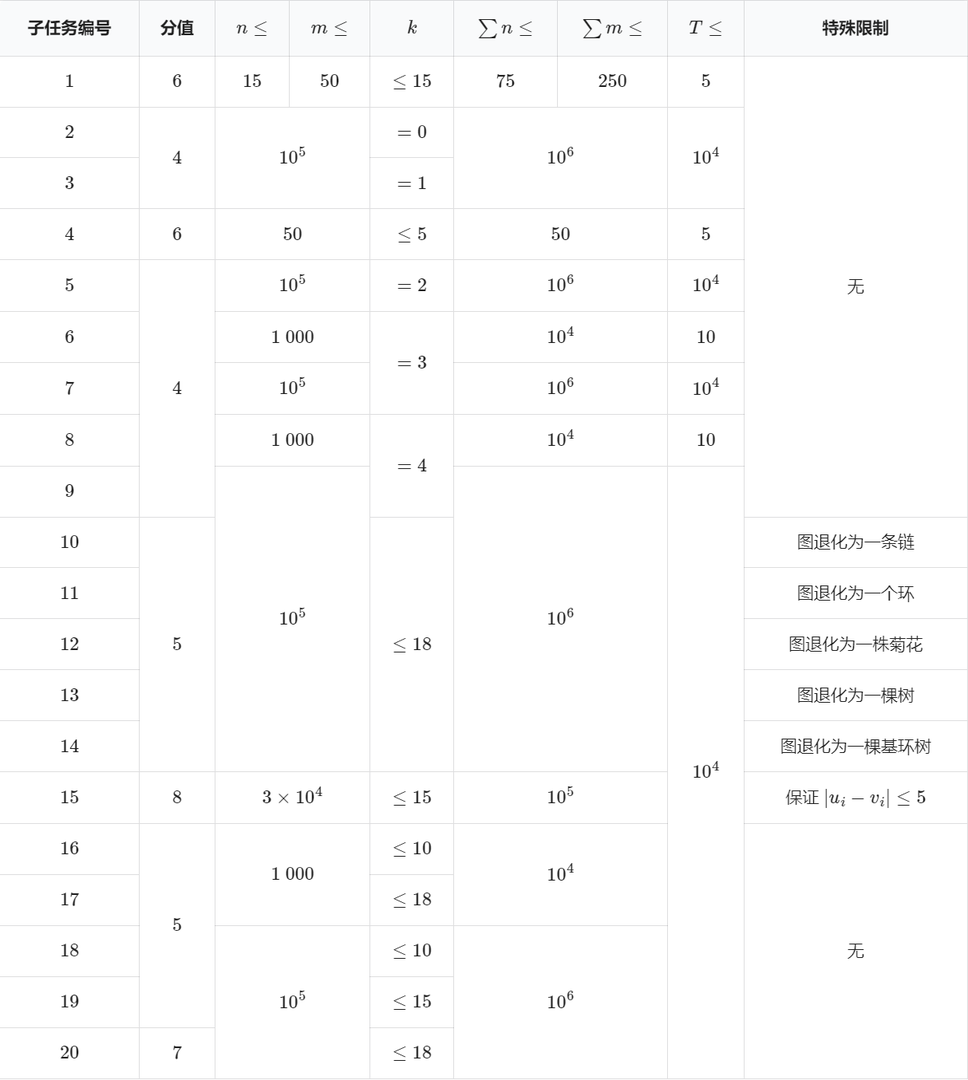
For $100\%$ of the data, it is guaranteed that $1\leq n\leq10^5$, $0\le m\le 10^5$, $0\leq k\leq \min(n-1,18)$, $1\leq T\leq 10^{4}$, $\sum n,\sum m\leq10^6$.
Also, for each test point:
Let $K=\max k$, i.e. the maximum value of $k$ among all test cases in this test point.
+ If $K\ge 17$, then $T=1$;
+ If $K\ge 15$, then $T\le 3$;
+ If $K\ge 10$, then $T\le 5$;
+ If $K\ge 5$, then $T\le 300$。
Translated by ChatGPT 5