P9163 "INOH" Round 1 - Knot
Description
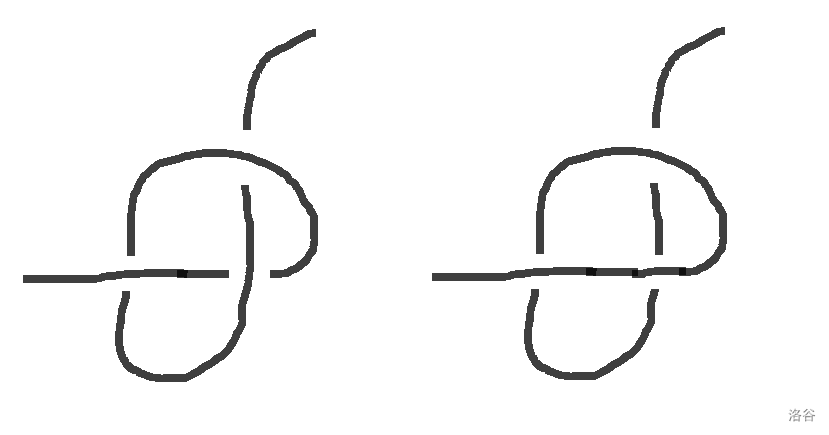
The figure above shows the planar projections of two knots.
We observe that a knot can be described by basic crossing points, and each crossing point is a double point.
That is, we can **use a point to represent a crossing, and connect crossings with edges of different types**.
You can see that **each point has four exits, and exits are connected to exits**. Among these four edges, **two are on the upper layer and two are on the lower layer**.
We use an ordered pair $(u, d)$ to represent such an exit.
Here, $u$ is the index of the point, and $d \in [0, 3]$. Also, **we define that $0$ and $1$ are the two upper edges, and $2$ and $3$ are the two lower edges**.
We also observe that a knot has two ends. These two ends can be connected to the outside. For convenience, we **use $(-1, 0)$ and $(-2, 0)$ to represent these two ends**.
Now you are given such a knot. You need to answer: when we pinch the two ends and pull hard, is it a slipknot (live knot) or a dead knot?
If it is a slipknot, output `Yes`. If it is a dead knot, output `No`.
Input Format
The first line contains the number of test cases $T$.
For each test case, the first line contains $n$, the number of nodes.
Then follow $n$ lines. On the $i$-th line there are eight integers $u_0, d_0, u_1, d_1, u_2, d_2, u_3, d_3$, describing the corresponding exits connected to exits $0$ through $3$ of node $i$.
In the $i$-th line, the first pair $(u_0, d_0)$ means that exit $0$ of node $i$ is connected to exit $d_0$ of node $u_0$, and so on.
Output Format
Output $T$ lines in total. Each line is `Yes` or `No`.
Explanation/Hint
### Constraints
**This problem uses bundled testdata**.
- Subtask 0 (20 pts): $T = 3$, $1 \le n \le 10$.
- Subtask 1 (20 pts): $T = 10^3$, $1 \le n \le 10$.
- Subtask 2 (10 pts): $T = 10$, $1 \le n \le 10^5$, and the testdata is guaranteed to be randomly generated.
- Subtask 3 (50 pts): $T = 10$, $1 \le n \le 10^5$.
### Sample Explanation
In sample 1 (the left figure), it is a dead knot.
In sample 2 (the right figure), it is a slipknot (live knot).

Translated by ChatGPT 5