P9229 Simple Nine Linked Rings
Background
**Hint: This problem has a large sample.**
**Hint: The “nine linked rings” in this problem are different from the traditional nine linked rings.**
Nine linked rings are a traditional Chinese puzzle game. As shown in the figure, nine rings are placed on a “sword” and are linked with each other.
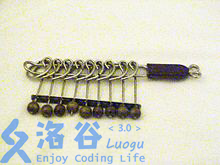
In the traditional nine linked rings, the $k(k\ge 2)$-th ring can be put onto the “sword” (denoted as $1$) or taken off the “sword” (denoted as $0$) if and only if the $(k-1)$-th ring is on the sword, and all rings before it are not on the sword. In particular, the $1$-st ring can be put on or taken off freely.
In this problem, we discuss a more general situation, although this simple nine linked rings may not necessarily be physically constructible.
Description
A simple nine linked rings can be viewed as two `01` strings: the rule string $s$ and the state string $t$, satisfying $|s|=|t|-1$. Here, $t_i=\texttt 1$ means the $i$-th ring is on, and $t_i=\texttt 0$ means the $i$-th ring is off.
Within the same game, $s$ never changes, while in each step $t$ changes the value at exactly one position (from `0` to `1` or from `1` to `0`). The simple nine linked rings is fully taken off if and only if all $t_i$ are `0`. The simple nine linked rings is fully put on if and only if all $t_i$ are `1`.
The rule of the simple nine linked rings is: $t_i$ is allowed to change if and only if $t_{1\sim i-1}$ is a **suffix** of $s$. It can be seen that the traditional nine linked rings is a special case where $s$ is `00...01`.
Given $s$, find the minimum number of steps needed to go from the fully taken-off state to the fully put-on state. Output the answer modulo $10^9+7$.
Input Format
The first line contains an integer $n$, the length of $s$. **Note that this is not the number of rings.**
The second line contains a `01` string $s$.
Output Format
One line containing an integer, the answer modulo $10^9+7$.
Explanation/Hint
### Explanation for Sample 1
At the initial moment, all rings are not on the sword, and the state string $t$ is `0000`.
In step 1, put on the $1$-st ring, and $t$ becomes `1000`.
In step 2, put on the $2$-nd ring, and $t$ becomes `1100`.
In step 3, put on the $3$-rd ring, and $t$ becomes `1110`.
Next, you cannot directly put on the $4$-th ring, because `111` is not a suffix of the rule string $s$ `011`. Therefore, in step 4 you should take off the $1$-st ring, and $t$ becomes `0110`.
Then in step 5, put on the $4$-th ring, and $t$ becomes `0111`.
In the last step, put on the $1$-st ring, and $t$ becomes `1111`, completing the goal.
### Explanation for Sample 2
This is the traditional nine linked rings, and there are exactly $9$ rings.
### Explanation for Sample 3
Sample 3 satisfies the constraints of test point $7$.
### Explanation for Sample 4
Sample 4 satisfies the constraints of test point $15$.
### Constraints
For $100\%$ of the testdata, $1\le n\le 2000$, $s_i\in\{\texttt 0,\texttt 1\}$.
|Test point ID|$\vert s\vert\le$|Special property|
|:-:|:-:|:-:|
|$1\sim 3$|$3$||
|$4\sim 6$|$15$||
|$7\sim 11$|$300$||
|$12\sim 13$|$1000$||
|$14$|$2000$|All $s_i$ are `0`.|
|$15\sim 17$|$2000$|The last character of $s$ is `1`, and all other positions are `0`.|
|$18\sim 25$|$2000$||
Translated by ChatGPT 5