P9322 [EGOI 2022] Superpiece / Super Piece
Background
Day 2 Problem B.
The statement is translated from [EGOI2022 superpiece](https://stats.egoi.org/media/task_description/2022_superpiece_en.pdf)。
[](https://creativecommons.org/licenses/by-sa/3.0/)
Description
You have an infinite chessboard. In this problem, the board is an infinite 2D grid, and each square is denoted by $(r,c)$, representing the row and the column. There is currently exactly one piece on the board, called the **superpiece**. You are given the list of legal moves of your superpiece as a non-empty string, which is a subsequence of `QRBNKP`. In each turn, the superpiece may move as one of the given chess pieces. The superpiece starts at $(a,b)$. Find the minimum number of moves needed to reach $(c,d)$.
The chess rules that may be used in this problem are as follows:
There are six kinds of pieces: queen, rook, bishop, knight, king, and pawn. Their moves are:
- **Queen** (`Q`) can move to any square in the same row, the same column, or the same diagonal. Formally, for any integer $k\ne 0$, the queen can move from $(a,b)$ to $(a+k,b)$, $(a,b+k)$, $(a+k,b+k)$, $(a+k,b-k)$.
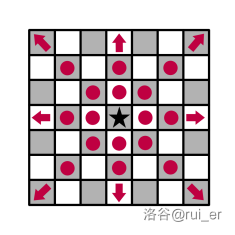
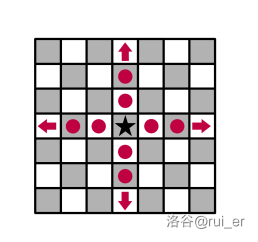
- **Rook** (`R`) can move to any square in the same row or the same column. Formally, for any integer $k\ne 0$, the rook can move from $(a,b)$ to $(a+k,b)$, $(a,b+k)$.
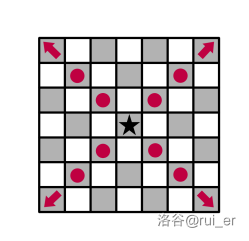
- **Bishop** (`B`) can move to any square on the same diagonal. Formally, for any integer $k\ne 0$, the bishop can move from $(a,b)$ to $(a+k,b+k)$, $(a+k,b-k)$.
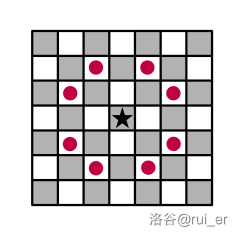
- **Knight** (`N`) moves in an `L` shape: first move two squares in one direction, then one square in a perpendicular direction. Formally, the knight can move from $(a,b)$ to $(a+1,b+2)$, $(a+1,b-2)$, $(a+2,b+1)$, $(a+2,b-1)$, $(a-2,b+1)$, $(a-2,b-1)$, $(a-1,b+2)$, $(a-1,b-2)$.
- **King** (`K`) can move to any of the eight adjacent squares. Formally, the king can move from $(a,b)$ to $(a,b+1)$, $(a,b-1)$, $(a+1,b)$, $(a-1,b)$, $(a+1,b+1)$, $(a+1,b-1)$, $(a-1,b+1)$, $(a-1,b-1)$.
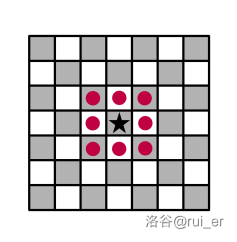
- **Pawn** (`P`) can move one square upward. Formally, the pawn can move from $(a,b)$ to $(a+1,b)$.
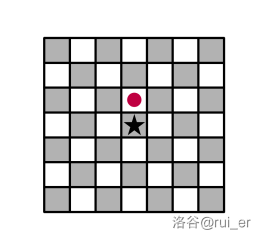
Note that other chess rules you may know do not apply to this problem; only use the rules listed above.
Input Format
The first line contains an integer $q$, the number of test cases. Then each test case is described by two lines:
- The first line of each test case contains a non-empty string, the legal move list of the superpiece. This string is a subset of `QRBNKP`, and all characters appear **in the same order**. In other words, it is a subsequence of `QRBNKP`.
- The second line of each test case contains four integers $a,b,c,d$, the starting and target positions of the superpiece. It is guaranteed that $(a,b)\ne (c,d)$, i.e., the start and target positions are different.
Output Format
For each test case, output one integer $m$ per line, the minimum number of moves. If it is impossible to reach the target position, output $-1$.
Explanation/Hint
**Explanation for Sample $1$**
In the first test case, we need to move from $(3,3)$ to $(5,1)$. The legal moves are knight, king, and pawn. There are many ways that take two moves, for example:
- Pawn to $(4,3)$, then knight to $(5,1)$.
- Knight to $(5,2)$, then king to $(5,1)$.
- King to $(4,2)$, then king to $(5,1)$.
There is no solution with fewer than two moves—we would need a bishop or a queen to do that.
In the second test case, we need to move from $(2,6)$ to $(5,3)$. Similarly, the optimal solution takes two moves. Here, every move must be a knight move, using $(4,5)$ or $(3,4)$ as an intermediate square.
---
**Explanation for Sample $2$**
In the first test case, we need to move from $(2,8)$ to $(3,6)$. The piece can only move like a bishop, which is impossible.
In the second test case, we need to move from $(2,8)$ to $(5,5)$. The piece can only move like a bishop. It can be done in two moves, for example by using $(4,4)$ as an intermediate square.
---
**Explanation for Sample $3$**
In the first test case, we need to move from $(3,3)$ to $(4,5)$. The piece can only move like a queen. We can use $(4,4)$ as an intermediate square and reach it in two moves.
In the second test case, we need to move from $(4,1)$ to $(1,4)$. The piece can only move like a queen and a rook. It can be reached in one move.
---
**Constraints**
For all testdata, $1\le q\le 10^3$, $-10^8\le a,b,c,d\le 10^8$.
- Subtask 1 ($12$ points): `Q` is guaranteed to exist, and `N` is guaranteed not to exist.
- Subtask 2 ($9$ points): `QN` is guaranteed to exist.
- Subtask 3 ($13$ points): `R` is guaranteed to exist, and `Q` is guaranteed not to exist.
- Subtask 4 ($8$ points): only `B` exists.
- Subtask 5 ($6$ points): `B` is guaranteed to exist, and `QR` is guaranteed not to exist.
- Subtask 6 ($31$ points): only `N` exists.
- Subtask 7 ($8$ points): `N` is guaranteed to exist, and `QRB` is guaranteed not to exist.
- Subtask 8 ($7$ points): `K` is guaranteed to exist, and `QRBN` is guaranteed not to exist.
- Subtask 9 ($6$ points): only `P` exists.
Note that the subtasks are **not** ordered by difficulty.
Translated by ChatGPT 5