P9564 [SDCPC 2023] Three Dice
Description
Dice are small, throwable objects with marked sides capable of landing in multiple positions. They are typically used to generate random values, especially in the context of tabletop games.
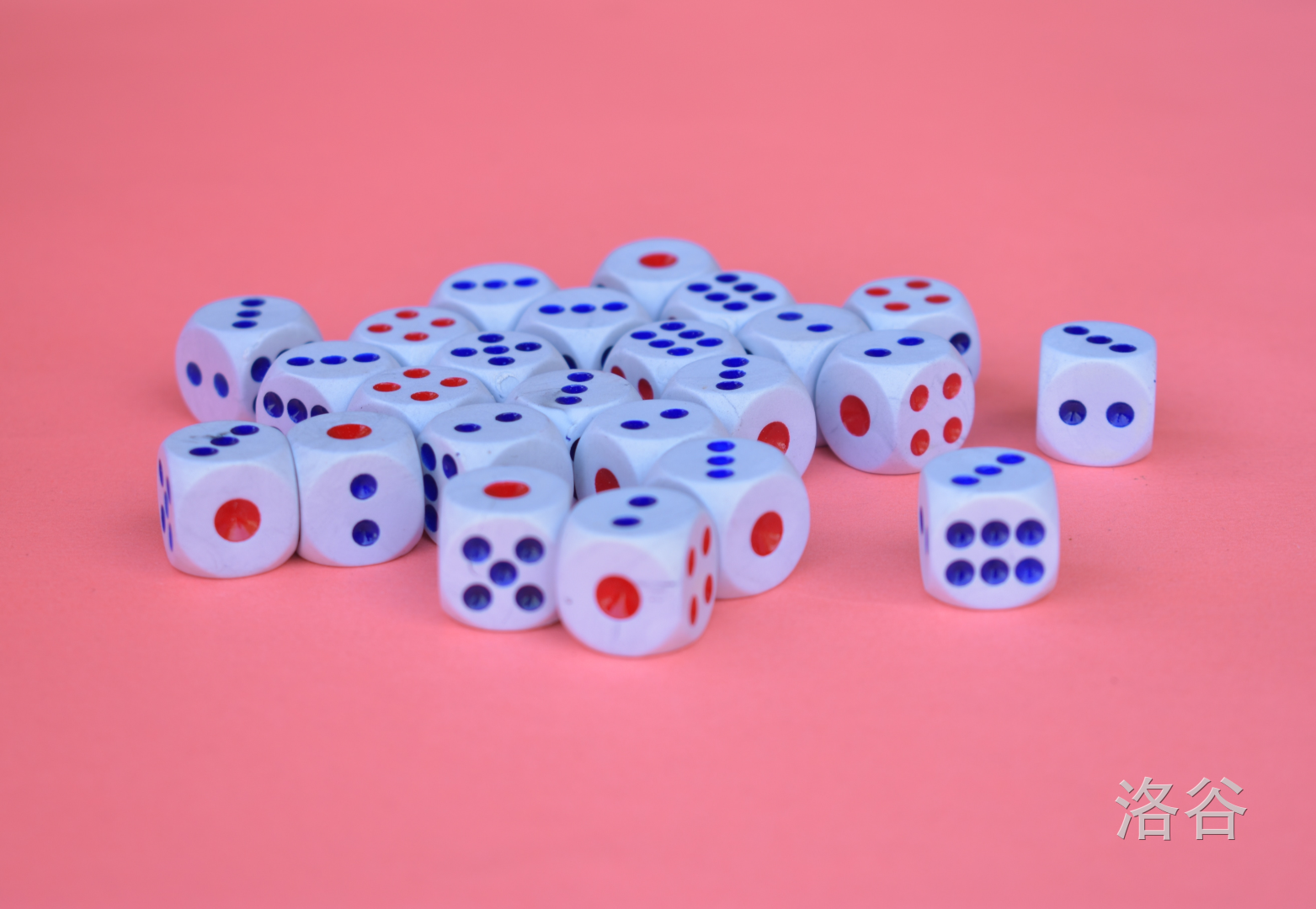
The most common dice are small cubes, with faces numbered from $1$ to $6$. Number $n$ ($1 \le n \le 6$) is usually represented by a pattern of $n$ round dots, known as pips. Moreover, the pips on the $1$ and $4$ faces are colored red, while those on the $2$, $3$, $5$ and $6$ faces are black.
Little Cyan Fish has three dice. One day, he threw them onto a table, and then observed the uppermost faces. He claimed that the total number of the red pips facing up was exactly $A$, and the total number of the black pips facing up was exactly $B$.
However, you find his claim doubtful. You want to verify whether it is possible to throw three dice such that the total number of red pips facing up is $A$, and the total number of black pips facing up is $B$.
Input Format
There is only one test case in each test file.
The first line of the input contains two integers $A$ and $B$ ($0 \leq A,B \leq 100$), indicating the total number of red pips facing up and the number of black pips facing up.
Output Format
Output one line. If it is possible for Little Cyan Fish to throw three dice such that the total number of red pips facing up is $A$, and the total number of black pips facing up is $B$ output `Yes`. Otherwise output `No`.
Explanation/Hint
In the first example, one possible solution is $4, 2, 3$.
In the second example, one possible solution is $1, 1, 1$.