P9565 [SDCPC 2023] Not Another Path Query Problem
题目背景
> What age is it that you are still solving traditional path query problems?
题目描述
**【题目背景】**
> 都什么年代了还在做传统路径查询问题?
在阅读《Distributed Exact Shortest Paths in Sublinear Time》这篇论文后,您学会了如何在 $\mathcal{O}(D^{1/3} \cdot (n \log n)^{2/3})$ 的复杂度内解决分布式单源最短路问题。为了测试您是否真的学有所成,小青鱼为您准备了如下问题。
小青鱼有一张包含 $n$ 个节点与 $m$ 条无向边的图,节点编号从 $1$ 到 $n$。第 $i$ 条边连接节点 $u_i$ 和 $v_i$,边权为 $w_i$。
对于任意一条连接节点 $u$ 和 $v$ 的路径,定义路径的价值为路径上所有边的边权进行按位与(bitwise AND)计算的结果。
小青鱼很喜欢高价值的路径,因此他设定了一个固定的阈值 $V$。称小青鱼喜爱一条路径,当且仅当这条路径的价值至少为 $V$。
接下来,小青鱼将会提出 $q$ 次询问,第 $i$ 次询问可以用一对整数 $(u_i, v_i)$ 表示。对于每次询问,您需要判断节点 $u_i$ 到 $v_i$ 是否存在一条小青鱼喜爱的路径。
输入格式
每个测试文件仅有一组测试数据。
第一行输入四个整数 $n$,$m$,$q$ 和 $V$($1 \le n \le 10^5$,$0 \le m \le 5 \times 10^5$,$1 \leq q \leq 5 \times 10^5$,$0 \leq V < 2^{60}$)表示图中的节点数以及边数,小青鱼的询问数以及固定阈值。
对于接下来 $m$ 行,第 $i$ 行输入三个整数 $u_i$,$v_i$ 和 $w_i$($1 \le u_i,v_i \le n$,$u_i \ne v_i$,$0 \leq w_i < 2^{60}$)表示一条连接节点 $u_i$ 和 $v_i$ 的无向边,边权为 $w_i$。两个节点之间可能存在多条边。
对于接下来 $q$ 行,第 $i$ 行输入两个整数 $u_i$ 和 $v_i$($1 \leq u_i, v_i \leq n$,$u_i \ne v_i$)表示一次询问。
输出格式
每次询问输出一行。若节点 $u_i$ 和 $v_i$ 之间存在一条价值至少为 $V$ 的路径输出 `Yes`,否则输出 `No`。
**【样例解释】**
接下来我们用 $\&$ 表示按位与计算。
第一组样例数据解释如下。
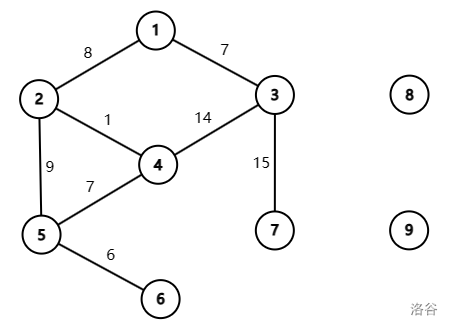
- 对于第一次询问,一条合法的路径为 $1 \to 3 \to 4 \to 5 \to 6$,其价值为 $7 \,\&\, 14 \,\&\, 7 \,\&\, 6 = 6 \ge 5$。
- 对于第三次询问,一条合法的路径为 $7 \to 3 \to 4 \to 5 \to 6$,其价值为 $15 \,\&\, 14 \,\&\, 7 \,\&\, 6 = 6 \ge 5$。
- 对于第四次询问,因为节点 $1$ 与 $8$ 之间不存在任何路径,因此答案为 `No`。
对于第二组样例数据仅有的一次询问,可以考虑由第 $2$ 和第 $4$ 条边组成的路径,其价值为 $5 \,\&\, 6 = 4 \ge 4$。
说明/提示
We now use $\&$ to represent the bitwise AND operation.
The first sample test case is shown as follows.

- For the first query, a valid path is $1 \to 3 \to 4 \to 5 \to 6$, whose value is $7 \,\&\, 14 \,\&\, 7 \,\&\, 6 = 6 \ge 5$.
- For the third query, a valid path is $7 \to 3 \to 4 \to 5 \to 6$, whose value is $15 \,\&\, 14 \,\&\, 7 \,\&\, 6 = 6 \ge 5$.
- For the fourth query, as there is no path between vertex $1$ and $8$, the answer is `No`.
For the only query of the second sample test case, we can consider the path consisting of the $2$-nd and the $4$-th edge. Its value is $5 \,\&\, 6 = 4 \ge 4$.