SP1003 QUILT - Little Quilt
Description
_Little Quilt_ is a small language introduced by Ravi Sethi in his book ‘Programming Languages’.
Here, a restricted version of Little Quilt is presented. The language is defined by the following BNF grammar:
< QUILT > ::= A | B | turn(< QUILT >) | sew(< QUILT >,< QUILT >)
A and B represent the two primitive quilts. Each primitive quilt corresponds to a matricial arrangement of 2 × 2 characters. turn() and sew() are operations over quilts.
The instruction turn(x) turns the quilt x 90 degrees clockwise. The following table illustrates the primitive quilts as well as examples of the effect of the turn() operation:
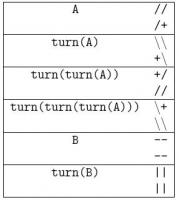
Accordingly, the instruction sew(x,y) sews quilt x to the left of quilt y. Both x and y must have the same height, otherwise an error will be generated. The following figure represents the result of sew(A,turn(B)):

while the sew(turn(sew(B,turn(B))),A) generates an error message.
Your job is to build an interpreter of the Little Quilt language.
Input Format
The input file will be a text file containing different Little Quilt expressions, each one ended by a semicolon character (;). Space and new line characters must be ignored; this means that an expression may span several lines.
Output Format
The output file contains the quilts produced as a result of interpreting the input expressions.
Each quilt must be preceded by a line, left aligned, with the format
Quilt i:
where i is the quilt number, starting at 1. If the expression interpretation generates and error, the word
error
must be printed.