SP2161 JPIX - Pixel Shuffle
Description
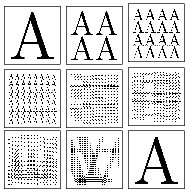
Shuffling the pixels in a bitmap image sometimes yields random looking images. However, by repeating the shuffling enough times, one finally recovers the original images. This should be no surprise, since "shuffling" means applying a one-to-one mapping (or permutation) over the cells of the image, which come in finite number.
Your program should read a number n , and a series of elementary transformations that define a "shuffling"  of n \* n images. Then, your program should compute the minimal number m (m > 0) , such that m applications of  always yield the original n \* n image.
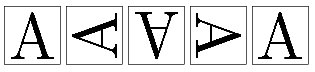
For instance if  is counter-clockwise 90 $ ^{o} $ rotation then m = 4.
Input Format
Test cases are given one after another, and a single 0 denotes the end of the input. For each test case:
Input is made of two lines, the first line is number n (2
Output Format
For each test case:
Your program should output a single line whose contents is the minimal number m (m > 0) such that  is the identity. You may assume that, for all test input, you have m < 2 $ ^{31} $ .